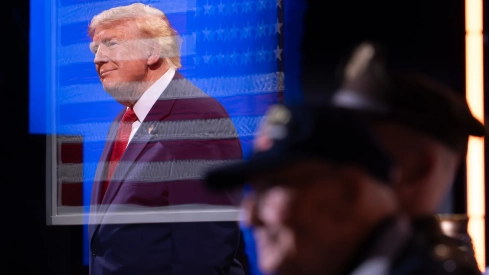
Donald Trump has once again turned a NATO summit into a problem for his own allies. As soon as he arrived in Ankara, the US president revived his old threat about Greenland and argued that the Arctic island "should be controlled by the United States, not by Denmark."
The statement came at the very beginning of the Atlantic meeting, just as allies are trying to show unity, military purchases, and commitment to increasing defense spending. Trump did the opposite. He reopened the clash with Denmark, questioning the sovereignty of a founding NATO country and once again presenting Europe as a burden for Washington.
The US president justified his position by Greenland's strategic value. According to Trump, the island is "very important" to the United States and is surrounded by Chinese and Russian ships. He also accuses Denmark of not investing enough in the territory. "That's what damaged my relationship with NATO," he even said about the European rejection of his plans.
The Danish response was not long in coming. Prime Minister Mette Frederiksen once again drew Copenhagen's red line and asked allies to respect the sovereignty of the Kingdom of Denmark. "Greenland is not for sale," she concluded. She also recalled that the Greenlandic territory itself has made it clear that it does not want to be part of the United States.
Trump's Arctic obsession returns to the scene
Greenland does not appear now by chance. It is an autonomous territory within the Kingdom of Denmark, with a key position between the Arctic and the North Atlantic, critical minerals, emerging routes due to melting ice, and clear military importance. The United States already has the Pituffik space base there, formerly Thule, essential for missile warning, space surveillance, and North American defense.
Trump has been eyeing Greenland for years as his own geopolitical piece. During his first term, he already proposed buying it. In this second cycle, the pressure escalated to the point of not publicly ruling out the use of force or economic measures against European allies. Denmark, Greenland, and the European Union then responded with an unusual closing of ranks.
The matter seemed to have cooled down after months of contacts between Washington, Copenhagen, Nuuk, and NATO. Trump himself had toned down his rhetoric in Davos and spoke of strategic access formulas, without formally touching sovereignty. In Ankara, he has returned to square one. Direct US control, reproaches to Denmark, and a veiled threat to the cohesion of the Alliance.
The paradox is evident. Trump demands more loyalty, more military spending, and more strategic obedience from Europe while questioning the territorial integrity of an ally. This clash strikes at the heart of NATO, an organization built on collective defense, trust among partners, and respect for the borders of its members.
Europe tries to calm Trump with more spending
The Ankara summit was already prepared to avoid another clash with Washington. NATO has put on the table large defense contracts, joint purchases, drones, aerial surveillance, and new industrial capabilities. Mark Rutte wants to show that Europe and Canada are complying with the shift towards more military investment.
Trump did not seem impressed. He again reproached Italy, France, Germany, and the United Kingdom for not supporting the United States in the war with Iran or in the reopening of the Strait of Hormuz. “We help them, but I’m not sure they would be there for us,” he said, before wondering why Washington spends so much money on allies who, according to him, do not respond when asked.
He also brought up another usual threat. He said that the United States could withdraw soldiers from Europe because the continent is no longer the same as twenty years ago. Then he added his usual ideological recipe against Europeans: immigration and energy. “If they are not careful with those two things, there will be no Europe left,” he warned.
The speech fits with Trump's ultra drift. A mix of territorial pressure, military blackmail, contempt for allies, and an identitarian reading of European problems. In Ankara, moreover, he has done so alongside Recep Tayyip Erdogan, whom he has praised as a “strong leader” while Turkey itself uses the summit to reinforce its position within the Alliance.
Denmark looks to its allies
For Denmark, the problem is not an isolated occurrence. Greenland is part of the Danish Realm, but it has self-government and its own debate about its future. Copenhagen agrees to discuss Arctic security, military cooperation, and greater allied presence. What it rejects is the United States treating the island as an asset that can change hands due to pressure from the president in office.
The issue also makes Brussels and the rest of the European capitals uncomfortable. If a NATO partner can publicly question the sovereignty of another in the middle of a summit, the discussion ceases to be only about Greenland. It becomes about the reliability of the United States as a guarantor of European security.
The summit will continue to talk about spending, Ukraine, drones, military industry, and capabilities. Trump has also forced a discussion about something much more uncomfortable. Denmark has once again heard from within NATO that an ally wants to control part of its territory.
