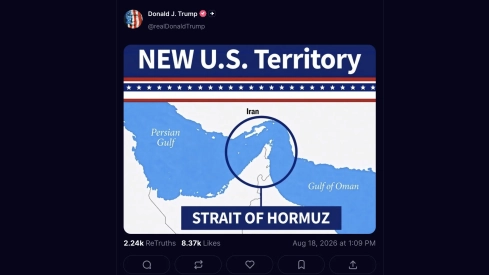
Donald Trump has converted this Tuesday one of the most delicate maritime routes on the planet into the latest stage of his expansionist rhetoric. The president of the United States has published on his social network, Truth Social, a map that presents the Strait of Hormuz as "NEW territory of the United States", despite Washington lacking sovereignty over those waters.
The image surrounds the maritime passage with a circle and adds a stripe with the colors and stars of the American flag. Trump has disseminated the montage as if it were a consummated reality, without accompanying it with any legal, diplomatic, or military explanation.
The Republican had already advanced his intentions on Friday during a rally in Long Island. There he assured that he would declare Hormuz American territory once Iran was defeated and used the naval blockade imposed by Washington as a supposed title of ownership. "No ship passes unless we want it to pass," he maintained.
Trump returned to the idea on Monday from the Oval Office, where he called it "very good" and affirmed that the United States had "total control" of the area. His publication this Tuesday converts that threat into presidential propaganda, although it still produces no change in the sovereignty of the strait.
A map without legal effect
The Strait of Hormuz separates Iran from the Omani Musandam peninsula and connects the Persian Gulf with the Gulf of Oman and the Arabian Sea. Sovereignty over its waters corresponds to the riparian states within their respective maritime spaces. The deployment of a fleet, a blockade, or a presidential declaration disseminated online does not grant territorial rights to the United States.
The United Nations Convention on the Law of the Sea recognizes riparian countries' competencies over their waters, airspace, seabed, and subsoil. At the same time, it establishes the right of transit passage for vessels and aircraft crossing straits used by international navigation. This regime obliges to facilitate circulation and limits the possibility of a state unilaterally closing the route.
The American military presence can alter traffic or impose a situation of force, but it does not convert Hormuz into Washington's territory. The threat of annexing the passage also directly affects Oman, one of the historical partners of the United States in the Gulf and the country that controls the southern coast of the strait.
The importance of Hormuz explains the scope of the provocation. Before the war initiated in February by the United States and Israel against Iran, more than 20 million barrels per day of oil and derived products circulated through its waters, around a fifth of world consumption. Also crossing the strait was close to 20% of international trade in liquefied natural gas, mainly from Qatar.
The conflict has drastically reduced these movements. The US Energy Information Administration estimates that oil and other liquids traffic fell to an average of 4.9 million barrels per day during the second quarter of 2026, compared to 21.6 million recorded before the war. Brent crude reached $91.63 per barrel this Tuesday amid deteriorating negotiations and fears of a new escalation.
The maneuver is incorporated into a long list of territorial aspirations launched by Trump since his return to the White House. The president has already proposed appropriating Greenland, turning Canada into the 51st state, and taking control of the Gaza Strip. Hormuz now adds a strategic maritime space to that policy of altered maps, threats, and faits accomplis.
Oman, under threat for mediating with Iran
The publication comes just hours after Trump directly threatened Oman over its talks with Tehran. "If Oman gets in the way, we will bomb them mercilessly," he declared during an interview with the US network 'Fox News'. He also demanded that Iran raise "the white flag" and surrender.
Muscat is negotiating with the Iranian government a system of safe routes to restore commercial navigation through the strait. The project contemplates the coordination of the two riparian states and security mechanisms for ships, although Washington rejects that Tehran can participate in traffic supervision or collect fees from vessels.
For decades, Oman has maintained a prudent foreign policy that has allowed it to act as a mediator between the United States, Iran, and other actors in conflict in the Middle East. It also provides facilities and logistical support to US forces. The Omani government has not yet publicly responded to Trump's latest threat.
The president's words also clash with Article 2 of the United Nations Charter, which prohibits the threat or use of force against the territorial integrity and political independence of States. Trump has threatened to bomb a country with which Washington maintains diplomatic and military relations because its authorities participate in a regional negotiation.
Iran has responded to the map through its Deputy Foreign Minister, Kazem Gharibabadi, who has called the American claims "illusions". The Iranian leader has warned that Tehran will be responsible for correcting them and has defended that the future of Hormuz must be decided among the countries of the area.
The new escalation coincides with the expiration of the 60-day period included in the memorandum signed by Washington and Tehran on June 17. Trump stated this Tuesday that talks are stalled, that there are no new meetings scheduled, and that he does not plan to extend that deadline.
The Iranian Parliament's president and chief negotiator, Mohamed Baqer Qalibaf, maintains that the strait will remain closed until the United States lifts the blockade of Iranian ports, withdraws oil sanctions, unfreezes frozen assets, and ends its military operations. While Washington proclaims that it controls Hormuz and that the route is open, commercial traffic remains at a minimum and vessels face increasing risk in increasingly militarized waters.
