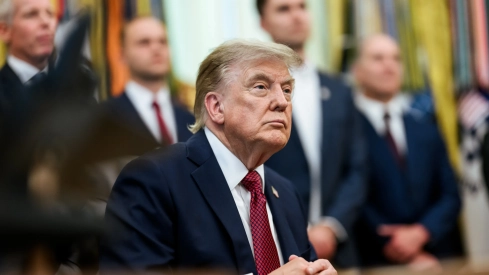
Donald Trump has needed a question on television to turn the tragedy of Ceuta into a campaign ad. The president of the United States has called the images from the autonomous city "terrible" and has immediately used them to attack Democrats, without dedicating a single word to the victims or asking Morocco for explanations for what happened on its border.
"It's terrible. Remember that image. That's how we'll be in three years if the wrong side wins," Trump said during a conversation with the conservative network 'Fox News'. The ultra leader has also warned that Americans "will not live very well" if Democrats return to power.
The crisis has left dozens dead and a city of around 85,000 inhabitants completely overwhelmed. The Ministry of Interior has estimated that some 50,000 people crossed from Morocco on Thursday, while the president of Ceuta, Juan Jesús Vivas, has raised the estimate to 60,000. Thousands have already begun to return to the neighboring country.
Trump has overlooked that human dimension to bring the conversation to Washington. Ceuta has served him to defend his deportation policy, fuel fear of immigration, and mobilize his electorate with four months to go until the legislative elections and the 2028 presidential race beginning to loom on the horizon.
Ceuta enters Trump's campaign
The US president has built much of his second term around the persecution of irregular immigration. His Administration has restricted access to asylum, deployed immigration agents in different states, and carried out massive raids and deportations that have provoked protests, accusations of abuse, and growing social opposition.
The White House has now presented Ceuta as the image of what would happen in the United States under a Democratic government. Vice President JD Vance has spoken directly of "the Invasion of the West" and has "thanked God" for Trump's electoral victory.
Thank God @POTUS was elected and our country’s border no longer looks like this.
— JD Vance (@JDVance) July 31, 2026
These images out of Spain are an unfortunate reminder of the consequences of mass migration and the radical left-wing globalist policies that have enabled the Invasion of the West.@BillMelugin_:… pic.twitter.com/b67fR3SEof
Vance has described what happened as a consequence of "mass migration and the globalist policies of the radical left." The message uses thousands of people as a uniform threat and removes from the images those who have died, the families who also crossed, and the minors who were caught in the avalanche.
Stephen Miller, Trump's main ideologue for immigration policy, has also used Ceuta to attack the opposition. The advisor has assured that Democrats will allow American homes to be "trampled and stolen by invaders" if they regain power. White House communications director, Steven Cheung, has spread the same framework by comparing the Spanish images with the border during Joe Biden's mandate.
The offensive has reached the State Department. The body led by Marco Rubio has expressed its support for the "people of Spain", but has directly blamed Pedro Sánchez's Government for the crisis. Washington accuses the Spanish Executive of making "deliberate efforts" to facilitate massive irregular immigration to Europe.
The United States stands with the people of Spain, and all Europeans, against this egregious violation of their sovereignty and human rights.
— Department of State (@StateDept) July 31, 2026
This unacceptable incident is the direct result of the Spanish Government's deliberate efforts to enable and facilitate mass illegal…
The message adds that the United States is studying measures to protect its citizens in Spain from this supposed threat and that it is willing to help other European allies. The State Department thus raises possible actions in the territory of a NATO partner while blaming its democratically elected Government without providing evidence of deliberate action.
The White House has also linked the massive entry with Spanish immigration policy. However, the people who have now arrived in Ceuta are outside the extraordinary regularization approved by the Government. The procedure closed on June 30, required being in Spain before January 1, and mandated proving at least five months of permanence.
The crisis has allowed Trump to reopen his confrontation with Sánchez just twelve days after the rapprochement staged during the World Cup final in New Jersey. The differences between both governments include defense spending, Spain's refusal to reach 5% of GDP, the use of the Rota and Morón bases during the Iran war, and Moncloa's position on Palestine and Israel.
The Moroccan ally that is left out of the blame game
Washington's harshness with Sánchez contrasts with its silence regarding Mohamed VI. Any complete explanation of what happened involves the Moroccan side of the border, from where tens of thousands of people managed to reach Ceuta by land and sea in just a few hours.
Moroccan forces have since deployed riot units, tear gas, and water cannons to stop new attempts. Rabat is also collaborating in the return of those who have decided to go back. It remains to be clarified how such a large concentration could have formed and why controls were overwhelmed during the first hours.
Trump, Vance, and the White House have reserved their attacks for Sánchez and the Democrats. None of their main messages has publicly demanded explanations from the Moroccan Government, despite the fact that the United States maintains a privileged relationship with Rabat and considers Mohamed VI one of its most important allies in North Africa.
Marco Rubio published this Thursday, when the crisis was already hitting Ceuta, an enthusiastic message of congratulations to the king on the anniversary of his accession to the throne. The Secretary of State defined Morocco as "a pillar of regional stability and security" and boasted of the longest-standing alliance in American history.
Rubio also took advantage of the statement to reiterate that the United States recognizes Moroccan sovereignty over Western Sahara and considers Rabat's autonomy plan as the only acceptable basis for resolving the conflict. Washington thus maintains the shift adopted by Trump in 2020, when he backed Mohamed VI's claims over the former Spanish colony.
The closeness between both governments has had a particularly personal expression this very week. Trump announced on Sunday that Morocco had decided to name after him the 1,055-kilometer highway that connects Tiznit with Dakhla and crosses a good part of the Western Sahara under Moroccan control. The president thanked Mohamed VI for the "great honor" and expressed his desire to soon travel the entire road.
Rabat has not yet publicly confirmed the change of name announced by Trump. The highway, operational since January and valued at about 1,000 million dollars, is part of the large projects with which Morocco intends to reinforce its economic and political control over the Sahara. The tribute comes after Trump gave Mohamed VI one of his greatest diplomatic successes by recognizing Moroccan sovereignty over the territory.
The favorable climate for Rabat has also reached influential sectors of the American right. Michael Rubin, former Pentagon advisor and analyst at the conservative American Enterprise Institute, has asked Trump and Rubio to recognize Ceuta and Melilla as "occupied Moroccan territory" and has even advocated a new 'Green March' on both cities.
Rubin currently holds no official position and his words do not represent Washington's formal position either. His proposals show the space that Moroccan claims have gained within certain neoconservative circles and those close to the MAGA movement, where hostility towards Sánchez coexists with a growing sympathy for Rabat's territorial aspirations.
The message of thanks to Mohamed VI remains pinned on Trump's 'Truth Social' profile. The US president assures there that he hopes to travel "hopefully soon" the highway that Morocco would have dedicated to his name.
Add ElConstitucional.es as a preferred Google source for free.
Stay informed about all the latest breaking news with the best information. Against disinformation, for democracy and social rights.
