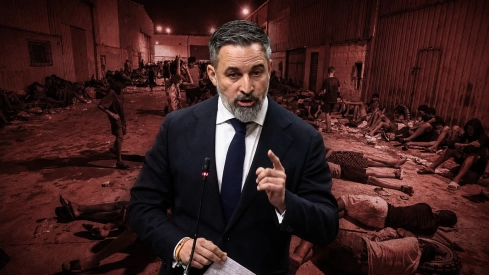
The far-right Vox has turned the migratory crisis in Ceuta into an offensive marked by xenophobia, dehumanization, and calls to act outside of institutions. Santiago Abascal this Friday called for the expulsion of all people who have arrived from Morocco "by whatever means necessary" and encouraged Spanish citizens to do so on their own if the Government does not act as he demands.
"They must be thrown out now! All of them! By whatever means necessary. And if the Government doesn't do it, it will have to be the Spanish people alone," the Vox leader wrote on 'X'. The message encourages individuals to assume a function reserved for the State and deliberately leaves unexplained what actions that threat of using any means encompasses.
Desgarrador testimonio de una española abandonada en Ceuta, como 80.000 españoles más.
— Santiago Abascal 🇪🇸 (@Santi_ABASCAL) July 31, 2026
¡Hay que echarlos ya!
¡A todos!
Con los medios que sea. Y si el gobierno no lo hace tendrán que ser los españoles solos. pic.twitter.com/hEHBLb0cHu
Abascal accompanied his words with the televised testimony of a resident of Ceuta and again presented Pedro Sánchez as a "traitor". Shortly after, he escalated the attack against the president. "They and he must be thrown out", he stated after the Executive's head visited the autonomous city.
The ultra leader had already held Sánchez responsible on Thursday for any crime that any of the people who arrived in Ceuta might commit in the future. "Every future stabbing and every future rape will have been directly imported by Sánchez", he assured in another message that linked immigration, crime, and sexual violence in advance.
The collective criminalization occurred while the latest published count raised to 57 the bodies recovered in the waters of Ceuta, most of them people who died trying to swim around the Tarajal breakwater. The Minister of Defense, Margarita Robles, responded to the far-right's warlike narrative by reminding that "this is not a war" and that those who have crossed are "human beings who come deceived."
From "hunting them one by one" to mass deportations
The Secretary General of Vox in Congress, José María Figaredo, took the discourse a step further during an interview on 'Espejo Público'. The deputy called for "hunting" migrants "one by one", deploying the Army, and immediately returning them to Morocco because, according to his definition, "they are invaders."
Figaredo has also demanded that "technicalities" be left behind. These procedures that the ultra leader despises are the legal guarantees that oblige the identification of each person, the protection of minors, the study of possible asylum applications, and the avoidance of collective expulsions. They also allow knowing if there are victims of trafficking, separated families, or people who need medical attention.
The Supreme Court ruled on July 8 that current legislation prevents the immediate rejection of those who access Ceuta or Melilla by swimming without overcoming a physical barrier. The Government has announced a line of buoys in Tarajal to adapt border control to that ruling and expedite repatriations within the legal framework.
Interior had already counted 37,500 voluntary returns to Morocco by 3:30 p.m., around 75% of the 50,000 entries estimated by the ministry. The state apparatus and cooperation with Rabat were managing thousands of departures while Abascal called on citizens to take justice into their own hands.
The national spokesperson for Vox's Agenda España, Isabel Pérez Moñino, has also traveled to Ceuta to fuel the same framework. She has spoken of "hordes of illegal immigrants" and "men of military age," has stated that "there is absolutely no room for anyone else in Spain" and has promised that the time for "mass deportations" will come.
Pérez Moñino has accused the Government of "promoting" the arrival of migrants and of providing them with alleged accommodation in five-star hotels. The leader has not provided evidence for these claims, habitually used by Vox to pit migrants against citizens affected by other emergencies.
She has also brought back the so-called "national priority," the proposal with which the far-right intends to establish differences by origin or nationality in access to benefits, housing, and public services. The president of Vox in Ceuta, Juan Sergio Redondo, for his part, has blamed Sánchez, Marlaska, and Juan Jesús Vivas, president of the city, for allowing a situation he has defined as the "chronicle of a death foretold."
The massive arrival also has no relation to the extraordinary regularization approved by the Government, despite Abascal having presented it as the direct cause of the crisis. The deadline to apply for it ended on June 30 and the procedure requires being in Spain since before January 1, 2026, and proving at least five months of continuous stay. Those who have now entered Ceuta are outside these requirements.
NO PUEDE ACERCARSE A LOS ESPAÑOLES.
— Santiago Abascal 🇪🇸 (@Santi_ABASCAL) July 31, 2026
PERO SI SE PASEA ENTRE LOS INVASORES SERÁ ACLAMADO.
HAY QUE ECHARLES A ELLOS Y A ÉL.
ES UN TRAIDOR.#Ceuta pic.twitter.com/NakBXD5N0b
Vox's offensive has also reached the streets. Several deputies of the party in the Ceuta Assembly cheered the insults directed against Pedro Sánchez when the president was leaving the Assembly Palace. Among the shouts, "son of a bitch," "traitor," and "scoundrel" were heard.
Upon his arrival at the heliport, Sánchez and Marlaska had already been received with insults and homophobic chants. The National Police had to intervene against some demonstrators on a day with a strong security deployment. The far-right Vox later used these protests to present the president as someone incapable of approaching Spaniards.
Abascal reserves "enemy" for Sánchez
The harshness used against migrants and the Government contrasts with the words dedicated by Abascal to Morocco. In June 2025, during an interview on the 'WorldCast' podcast, the far-right leader stated that "Morocco is not the enemy" and defended a good relationship with the neighboring country based on mutual respect.
Abascal then spoke of Moroccan aspirations over Ceuta and Melilla, questioned Sánchez's relationship with Mohamed VI, and defended the need to build "high fences." Even with these criticisms, he made his position clear. "I don't think Morocco is the enemy," he repeated during that conversation.
Hace dos meses Abascal dio un giro de 180 grados a su discurso y pasó de insultar a Mohamed VI a defender que Marruecos no es el enemigo.
— Víctor Egío (@EgioVictor) July 30, 2026
Nada es casual. Abascal es el peón en España de Trump y Netanyahu y el principal beneficiario de la operación de desestabilización marroquí en… pic.twitter.com/FUJcmy9GPu
The contradiction has now returned with special force. Abascal avoids calling the country from which the massive entry has occurred an enemy, but uses that word against the president of Spain. Vox has requested the appearances of José Manuel Albares and the director of the CNI to learn about the contacts maintained with Rabat, although its main public offensive continues to be directed against migrants and the Government.
Donald Trump, one of Vox's great international allies, has also taken advantage of the crisis to attack his internal adversaries. The US president has assured that the United States could end up like Ceuta in three years if the Democrats win. A Spanish emergency with dozens of deaths has ended up becoming electoral material for the far-right on both sides of the Atlantic.
Abascal's history in the city helps to understand the institutional reaction provoked by his words. The Ceuta Assembly declared him persona 'non grata' in July 2021, after he pointed to part of the population and the Muslim representatives of the city as "pro-Moroccan" and "fifth columnists" at the service of Mohamed VI's aspirations.
The initiative was approved with the votes of PSOE, MDyC and Caballas and the abstention of the PP. The declaration was political in nature and had no legal effects. Its origin was in statements that the Assembly considered false, extremist and dangerous for coexistence, not only in the use of the word "invasion", as several media outlets close to the far-right have now tried to present.
Juan Jesús Vivas then defended the PP's abstention because he considered Abascal's words "extraordinarily serious". The Ceuta president maintained that the social and religious diversity of the city demanded special responsibility from those who came there in times of tension.
Five years later, Abascal has once again used a border crisis to call on citizens to act on their own, Figaredo has called for "hunting" people and several Vox deputies have cheered insults against Sánchez from the streets of Ceuta.
Add ElConstitucional.es as a preferred Google source for free.
Stay informed about all the latest breaking news with the best information. Against disinformation, for democracy and social rights.
