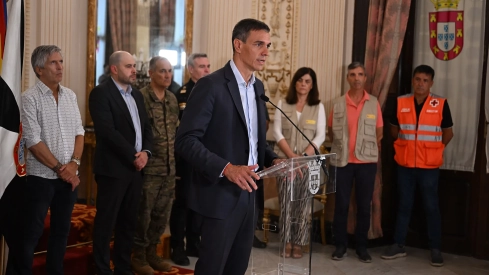
The Government will deploy a barrier of buoys at the Tarajal breakwater, accelerate repatriation files, and reinforce the presence of security forces in Ceuta. Pedro Sánchez announced these measures this Friday after visiting the border and meeting with the authorities responsible for the device activated in response to the largest migratory entry recorded in the autonomous city.
The president described what happened on Thursday as "an attack" and a "violation of Spain's territorial integrity". From the Assembly Palace, Sánchez conveyed the Executive's "rejection and condemnation" of a crisis that has placed tens of thousands of people within a city of just over 83,000 inhabitants.
The Interior Ministry estimates that some 50,000 people entered irregularly from Morocco, while the president of Ceuta, Juan Jesús Vivas, raises the estimate to 60,000. The movement has reversed this Friday, and 37,500 people had already returned to Moroccan territory by 3:30 p.m. At some moments, the outflow reached an approximate rate of 150 people per minute.
The tragedy continues to grow in the waters near the border. The latest available count raises the number of deceased during the crossings to 57, most of them drowned while trying to swim around the Tarajal breakwater. The Government Delegation had previously confirmed 41 bodies, and GEAS divers are keeping the search operation open, so the toll may increase.
Sánchez assured that the Executive understands the "anguish" and "emotional state" of the people of Ceuta after a day that overwhelmed the streets, emergency services, and reception resources. "All of Spain is with the people of Ceuta," he affirmed before committing all necessary means to protect the city's security, coexistence, and tranquility.
Buoys to apply the Supreme Court ruling
The first measure announced will be the installation of buoys on the breakwater that separates Ceuta from the Moroccan town of Fnideq, formerly Castillejos. The Civil Guard will deploy this line to visually delimit the border and create a new element of maritime containment.
The Government intends to adapt the device in this way to the ruling issued by the Supreme Court on July 8. The resolution prevented the application of so-called 'hot returns' to those who reach Ceuta or Melilla by swimming without overcoming a fence or other physical border containment element.
The court itself indicated that legislation allows for the establishment of containment elements in the sea. The Executive believes that the line of buoys will allow for border rejection to be applied to those who try to cross it, within the limits set by the Supreme Court and with the guarantees provided by immigration and international protection regulations.
Sánchez has also opened the door to "modifying some aspects of the laws" to make repatriations more efficient. The Government will also enable a temporary facility to identify, register, and assist people remaining in Ceuta, as well as to process more quickly the files of those who lack authorization to remain in Spain.
El Gobierno garantizará la seguridad de los vecinos y vecinas de Ceuta, intensificando la presencia de las Fuerzas y Cuerpos de Seguridad en las calles de la ciudad.
— Pedro Sánchez (@sanchezcastejon) July 31, 2026
Además, vamos a desplegar una barrera física de contención en el mar para facilitar la repatriación en frontera,… pic.twitter.com/Mj2LrcoBV9
The president hopes that people who entered irregularly will be repatriated "as soon as possible". Voluntary returns have relieved some of the pressure on the city during the afternoon, although security forces still need to identify and assist thousands of people dispersed throughout different neighborhoods or concentrated around reception resources.
The situation of minors will have its own processing. Sánchez has avoided offering a specific figure and has defended that Spain has a "safe legal framework" to protect them and individually study each case. He also recalled that, during the May 2021 crisis, numerous Moroccan families requested the return of their children and hopes that this movement will occur again.
Marlaska stays in Ceuta and Morocco must accelerate
Fernando Grande-Marlaska will remain in Ceuta for the next few days to personally monitor the evolution of the crisis and coordinate the state operation. The Army continues to support the Civil Guard, and the National Police maintains its reinforced presence in the streets and at the main concentration points.
The operation includes intervention and prevention units of the National Police, reinforcements from the Civil Guard's Reserve and Security Group, and two groups of GEAS divers. The Government also has up to 3,000 military personnel in Ceuta ready to collaborate with security forces and assist the population, as explained by Defense Minister Margarita Robles.
Sánchez has thanked Morocco for its offered collaboration, although he has asked Rabat for "more agility" and a "much more forceful" response. The president considers that the communication maintained during these hours has been "constant, fluid, and very reasonable," a difference he highlighted compared to the diplomatic and border crisis of May 2021.
The head of the Executive has defended that Morocco remains "an allied country" and recalled that irregular immigration was reduced by 40% during 2025 and another 36% so far in 2026. Thursday's entry breaks that trend and multiplies by more than twenty the accumulated arrivals in Ceuta during the first six and a half months of the year.
Sánchez attributes the immediate origin of the crisis to mafias dedicated to human trafficking, who would have spread on social networks a self-serving interpretation of the latest Supreme Court ruling. According to the president, these organizations conveyed the idea that those who arrived by swimming could not be returned to Morocco, thus fueling the massive movement towards the border.
The previous major crisis in Ceuta resulted in nearly 10,000 entries during two days in May 2021. This time, the Interior Ministry estimates that the figure has multiplied by five in just one day. The Government expects that cooperation with Rabat will allow for the completion of repatriations and the gradual return to normality during the coming hours, while Marlaska remains in the city and search efforts continue at sea.
Add ElConstitucional.es as a preferred Google source for free.
Stay informed about all the latest breaking news with the best information. Against disinformation, for democracy and social rights.
