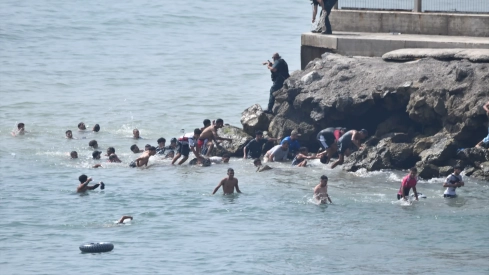
Spain can return people who have entered Ceuta irregularly, but cannot immediately hand them over to Morocco if they have arrived by swimming. That is the limit just set by the Supreme Court and which conditions the agreement announced this Thursday by the two countries to return "as soon as possible" those who have crossed the border in recent days.
The difference is decisive given the dimension of the crisis. Hundreds of people accessed this Thursday through the Tarajal breakwater and across the sea, while around 800 wait in the vicinity of the Temporary Immigrant Stay Center. The CETI already houses more than 700 residents despite having 512 places, and resources for minors are also overwhelmed.
The Ministry of Interior has assured that Spain and Morocco will strengthen their coordination and review the necessary measures to hand over all people who have entered illegally. The statement does not yet explain what procedure will be used, how those who arrived by land and by sea will be distinguished, or what will happen to the hundreds of minors.
The Supreme Court obliges to identify and process each return
The judgment 814/2026 of the Administrative Litigation Chamber, dated June 29 and publicly disseminated on July 8, resolved a very specific issue. The tenth additional provision of the Immigration Law allows the so-called border rejection when a person tries to overcome the containment elements of Ceuta or Melilla, such as fences.
This mechanism allows agents to prevent entry and immediately return the person to the other side of the border. The Supreme Court has concluded that this authorization does not extend to those who are intercepted at sea while trying to arrive by swimming, since on that route they have not overcome any physical barrier placed to prevent passage.
The dispute stemmed from the handover to Morocco of an Algerian citizen intercepted on November 14, 2024, along with two other people, when he was swimming towards Ceuta. The return occurred without administrative resolution, lawyer, or effective possibility of requesting international protection. A Ceuta court annulled the action, the High Court of Justice of Andalusia confirmed the ruling, and the State Attorney's Office appealed to the Supreme Court.
The magistrates have rejected the argument that thermal cameras, drones, or sensors can be considered containment elements. These devices serve to monitor and detect movements, but they lack the physical capacity to prevent or retain crossing.
The ruling also does not prevent any returns. Those who arrive by sea can be taken to police facilities, identified, and subjected to the procedure provided for in article 58.3 of the Immigration Law. Return requires a resolution from the government delegate, and the affected person has the right to a lawyer and an interpreter.
When a request for international protection is formalized, the return is suspended until the application is inadmissible or resolved. If the return cannot be executed within the first 72 hours, any subsequent internment requires judicial authorization. Possible illnesses, pregnancies, and other situations of special vulnerability must also be examined.
Unaccompanied foreign minors follow a different path. They must remain under the protection of the competent administration, and their eventual repatriation requires knowing their family circumstances, listening to them when they have sufficient maturity, and proving that the return is in their best interest. The collective handover announced by the Interior Ministry also cannot be automatically applied to them.
The Supreme Court did leave a door open for the future. The ruling states that border rejections by sea could be used if the State installed "containment elements in the sea" that materially fulfilled the same function as land fences.
That phrase raises a legal possibility, but the court does not order the installation of maritime barriers nor does it determine which devices would meet the necessary conditions. Such an action would also have to respect the safety of people in the water, maritime law, international protection, and the principle that prevents returning someone to a country where they may suffer persecution or ill-treatment.
Legal sources consulted by 'Europa Press' consider it legitimate to adopt measures in the face of a crisis of this magnitude, although they warn of the risk of reducing the problem to a ruling precisely aimed at guaranteeing rights. The pressure on Ceuta also has humanitarian, social, diplomatic, and economic dimensions that would remain present even if the return system were modified.
The journalist specializing in Morocco, Ignacio Cembrero, has expressed his doubts on 'Cadena SER' about the speed promised by both governments. He has described the announcement as a possible "empty promise" and considers it very difficult for adults who arrived by sea to be massively returned in the coming days.
The legal precision is important. The Supreme Court allows their return, but requires it to be done through the corresponding procedure and after studying each situation. Morocco's mere willingness to receive them does not allow skipping these procedures.
Interior prepares returns while the PP seeks to change the law
The agreement reached this Thursday may facilitate Morocco's acceptance of people whose return is legally agreed upon. Before that, they will have to be identified, their nationality determined, their entry route checked, and any asylum request or vulnerability circumstance resolved.
Interior maintains that human trafficking networks are taking advantage of the ruling to encourage young people to cross the sea. The department led by Fernando Grande-Marlaska also defends Moroccan collaboration and assures that its security forces have prevented thousands of attempts in recent days. The SUP and Jupol unions offer a conflicting version and denounce passivity on the other side of the border.
The president of Ceuta, Juan Jesús Vivas, calls for an urgent modification of the Immigration Law. He considers that the judicial pronouncement has created a new operational scenario and has asked the State to find a formula to recover immediate rejections for maritime entries.
The Popular Party has already registered an organic law proposal to extend the special regime to those who are detected or intercepted during an attempt to enter through the land or sea border. The Congress Bureau admitted the initiative on July 23 and the text was published four days later. Its consideration will be voted on after the summer.
The proposal expressly maintains respect for European Union Law, international protection, and the principle of non-refoulement. It will need an absolute majority in a final vote because it is an organic reform. Its approval would also not resolve the situation of those who are already inside Ceuta, because border rejection acts while the entry attempt is still occurring.
The Government has not confirmed whether it will support this reform nor has it announced the installation of maritime barriers. Its immediate response involves reinforcing surveillance, expanding reception resources, and executing returns that can be processed in accordance with current legislation.
Grande-Marlaska will travel this Friday to Ceuta to meet with Vivas, the Government Delegation, and the commanders of the National Police and the Civil Guard. There he must specify how many returns he intends to make, what procedure he will follow, and how he plans to fulfill the promise of returning "everyone" without violating the criterion just set by the Supreme Court.
Add ElConstitucional.es as a preferred Google source for free.
Stay informed about all the latest breaking news with the best information. Against disinformation, for democracy and social rights.
