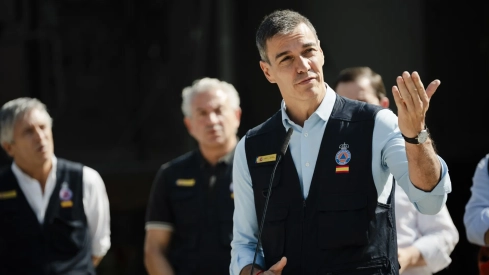
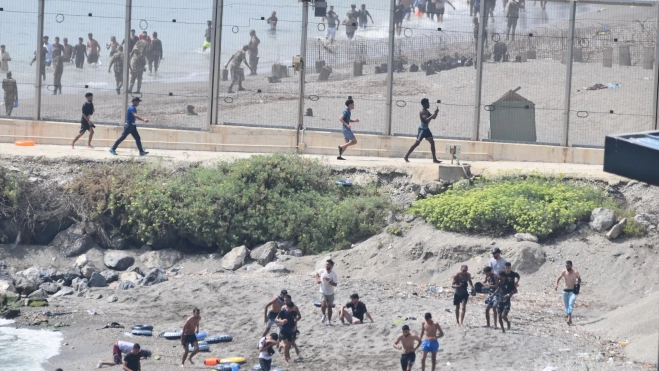
Pedro Sánchez has mobilized the Government to provide an immediate response to the migratory crisis that has overwhelmed the Ceuta border this Thursday. Hundreds of people have crossed from Morocco on foot, circumventing the Tarajal breakwater or throwing themselves into the sea, on a day that has pushed agents and reception services in the autonomous city to their limit.
The situation worsened in the early afternoon, when numerous migrants broke the cordon formed by the National Police at the exit of the border crossing and began to enter Ceuta. Riot police had tried to contain them with shields and defenses to prevent their dispersion towards the neighborhoods of Los Rosales and El Príncipe.
Sánchez has spoken by phone with the president of Ceuta, Juan Jesús Vivas, and has informed him that the Executive is already working to regain control. Moncloa is coordinating the actions of Interior, Migrations, Territorial Policy and Childhood, in addition to maintaining permanent contact with Moroccan authorities.
"We are mobilizing all necessary resources, working with Moroccan and international authorities, and preparing the necessary measures to restore normality as soon as possible," the president explained. Sánchez has called for the coming hours to be faced with "responsibility and cooperation."
El Gobierno de España está volcado en dar una respuesta inmediata a la situación en Ceuta.
— Pedro Sánchez (@sanchezcastejon) July 30, 2026
Estamos movilizando todos los recursos necesarios, trabajando con las autoridades marroquíes e internacionales, y preparando las medidas necesarias para recuperar la normalidad lo antes…
The Minister of Interior, Fernando Grande-Marlaska, will travel to Ceuta this Friday to follow the evolution on the ground. He will hold meetings with Vivas, the Government Delegation, and the commanders of the National Police and the Civil Guard, while reinforcements continue to arrive to restore operational capacity at the border.
Spain and Morocco strengthen their coordination
The governments of Spain and Morocco have agreed to strengthen surveillance and review available mechanisms to manage people who have entered irregularly. Interior wants to streamline their identification and applicable return procedures, respecting the guarantees provided in immigration legislation, the right to asylum, and the special protection of minors.
Grande-Marlaska has remained in contact with his Moroccan counterpart, Abdelouafi Laftit, throughout the day. The minister thanked the efforts made on the other side of the border, where, according to Interior, Moroccan security forces have prevented thousands of entry attempts in recent days.
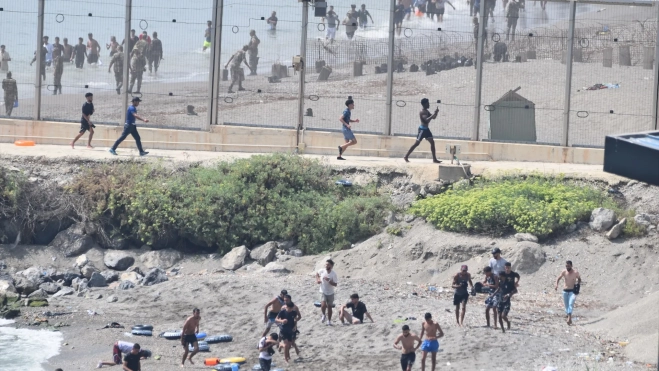
This collaboration proved insufficient to prevent Thursday's overflow. Thousands of people gathered in the vicinity of Castillejos and hundreds reached Spanish territory in different waves. Some crossed on foot along the breakwater while others used floats, fins, and wetsuits to go around it by sea.
Interior and the Moroccan Embassy in Madrid attribute the movement to networks dedicated to human trafficking. Both maintain that these organizations are spreading false expectations after the recent Supreme Court ruling on the so-called 'hot returns'.
The ruling, issued on July 8, established that the immediate rejection provided for Ceuta and Melilla can only be applied to those who attempt to overcome the physical containment elements of the border, such as fences. People intercepted at sea must be identified and subjected to the corresponding administrative procedure.
The Government believes that the networks have used this resolution to promote departures, especially among young Moroccans. Migrant assistance organizations reject reducing the causes of the crisis to a supposed pull effect and recall that arrivals had increased sharply in the months prior to the ruling.
Agents and reception centers at their limit
The Civil Guard has focused its efforts on rescuing those arriving by sea, some of them exhausted or injured after several hours in the water. The National Police then handles identifications and the opening of files. Both forces have warned that their units in Ceuta are overwhelmed after more than a week of constant pressure.
The police deployment has been reinforced with personnel from the Civil Guard's Reserve and Security Groups and new riot units. Another vessel has also been sent to support maritime services, while officers usually stationed in the city accumulate continuous days of rescues, custody, and identification.
The reception capacity also does not allow absorbing all arrivals. The Temporary Immigrant Stay Center keeps its doors saturated, and hundreds of people remain in the surroundings waiting to be attended to. The facilities for minors already house around 700 children and adolescents, well above the available places.
Ceuta has enabled provisional resources and demands accelerating transfers to the Peninsula. New arrivals need healthcare, food, dry clothes, and a space to stay while their situation is determined. Difficulties in identifying everyone still prevent knowing a definitive official figure of entries registered this Thursday.
The crisis also entails a serious human cost. At least 29 bodies have been recovered on the Ceuta coast since January, ten of them during July. Six bodies have appeared since last Saturday, while rescue teams continue searching for possible missing persons in the waters near Tarajal.
The Spokespersons' Board of the Ceuta Assembly has unanimously requested a declaration of a situation of interest for National Security, the temporary closure of the border, and the participation of the Army. Vivas has specified that his request is based on the National Security Law, a different path from the emergency declaration contemplated by civil protection regulations.
Sánchez has not yet confirmed that he will activate that figure. The president has pledged an extraordinary and coordinated response, while Sumar demands expanding reception and avoiding any return that violates the right to asylum. Canary Islands has also shown its solidarity with Ceuta and has called for a joint intervention by the State and the European Union.
Entries in Ceuta grow while they decrease in Spain
The current pressure was reflected in the Interior Ministry's statistics. Between January 1 and July 15, 2,826 people entered Ceuta irregularly by land, compared to the 1,133 recorded during the same period in 2025. The increase reached 149%.
Ceuta thus concentrates a very different evolution from that of the country as a whole. Spain registered 14,479 irregular arrivals until July 15, 24.7% less than during the same period last year. Maritime entries decreased by 36.1% and arrivals to the Canary Islands fell by 61.2%.
The national decline coexists with very specific pressure points. Arrivals by sea to the Peninsula and the Balearic Islands grew by 8%, while Ceuta and Melilla added 2,991 land entries, 140% more. The Ceuta border has become, during July, the main critical point of a migratory route that changes rapidly according to control, climate, and the activity of networks.
The massive entry has brought back images from May 2021, when thousands of people crossed from Morocco during a diplomatic crisis with Spain. The political difference now lies in the relationship between both governments. Madrid and Rabat maintain that their cooperation remains intact and have agreed to strengthen it in the coming hours.
Grande-Marlaska will arrive in Ceuta this Friday to review the deployment, coordinate humanitarian aid, and finalize the next measures with local authorities. The immediate priority will be to recover identification and reception capacity, reinforce surveillance of Tarajal, and prevent new uncontrolled entries.
Add ElConstitucional.es as a preferred Google source for free.
Stay informed about all the latest breaking news with the best information. Against disinformation, for democracy and social rights.
