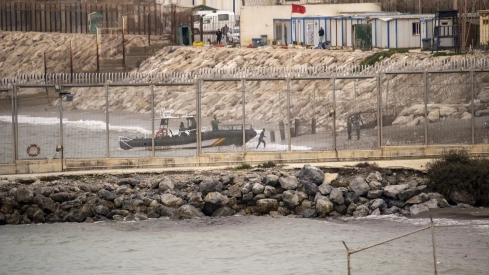
The Supreme Court has set a clear limit on "hot returns" in Ceuta and Melilla. The Immigration Law does not allow applying express rejection to migrants intercepted on the high seas when they try to reach Spanish territory by swimming. If entry occurs by water, it cannot be treated the same as a fence jump.
The ruling by the Contentious-Administrative Chamber rejects the appeal by the State Attorney's Office and confirms the criterion already held by a Ceuta court and the High Court of Justice of Andalusia. The specific case affects an Algerian citizen who was handed over to Morocco on November 14, 2024, along with two other people, after being intercepted at sea while trying to reach Ceuta.
The migrant reported that he was returned de facto, without procedure, without administrative resolution, without legal assistance, and without a real possibility of requesting international protection. He also requested compensation of 6,000 euros for moral damages and measures to return to Spain. The courts ruled in his favor regarding the illegality of the return, although they did not accept the compensation.
The sea is not a fence
The key lies in the tenth additional provision of the Immigration Law. This norm allows rejecting at the border those who are detected on the border line of Ceuta or Melilla while trying to overcome “border containment elements”. Until now, this debate had mainly revolved around fences.
The Supreme Court now clarifies that this special regime cannot be stretched to cover any attempt at irregular entry, whether by land or by sea. It can only be applied when the person tries to cross by overcoming a physical barrier established to contain entry, as occurs with border fences.
The Chamber rejects equating these barriers with drones, sensors, thermal cameras, or other maritime surveillance systems. These means serve to detect, control, and warn. They do not physically impede passage or retain those who try to cross. For the court, this difference is enough to exclude from express rejection those who are intercepted in the water.
The ruling has an immediate practical consequence. In cases like that of the Algerian citizen, what applies is not an automatic return, but the ordinary return procedure provided for in the Immigration Law. This implies minimum guarantees, administrative resolution, and the possibility of exercising basic rights, including legal assistance and the eventual request for international protection.
The ruling also leaves a technical door open. The Supreme Court points out that, if in the future the State were to install true containment elements in the sea to protect the border line, the application of border rejection to those who overcome them could be studied. Today that situation does not exist. Maritime surveillance does not equate to a barrier.
The resolution comes at a time of strong political pressure on the southern border and in full hardening of the migratory discourse of the right and the far-right. Against those who present Ceuta and Melilla as a space without rules, the Supreme Court reminds that even at the border there are procedures, guarantees, and legal limits.
The Interior Ministry argued that border rejection was also in accordance with the law in this case. The high court has closed that avenue. If a person is intercepted at sea trying to reach Ceuta or Melilla, the Administration cannot hand them over to Morocco without further ado.
The ruling leaves a simple rule for the maritime border: without a fence or physical barrier to overcome, there is no hot return.
