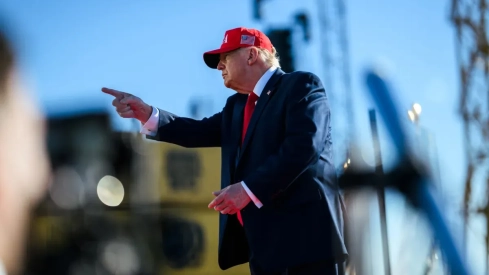
The president of the United States, Donald Trump, has questioned the victory of Luiz Inácio Lula da Silva in the Brazilian presidential elections after the progressive leader defeated far-right senator Flávio Bolsonaro, son of former president Jair Bolsonaro. Trump has hinted that irregularities occurred in the voting, but has not presented evidence to support his accusations.
Lula has secured a new term after winning the second round with 51.79% of the votes, compared to 48.21% obtained by his rival, according to official results. The Brazilian president has achieved a historic comeback after trailing Bolsonaro in the first round and has finished with more than four million votes ahead.
Flávio Bolsonaro's defeat also represents a setback for right-wing sectors that sought to regain power in Brazil and strengthen their political alliance with Trump. The result keeps Lula, one of the main references of the Latin American left, at the head of the country, and curbs the advance of the US president's allies in the region.
Trump again questions elections without presenting evidence
Trump has cast doubt on the result of the Brazilian elections and has compared Bolsonaro's defeat with Joe Biden's victory in the United States in 2020, elections whose results the Republican refused to accept. The US president has suggested that a supposed "Joe Biden playbook" has been followed in Brazil and has stated that "communists do not let go of power once they get it". However, his statements have not been accompanied by evidence to show that the election result was manipulated.
Trump's words once again bring to the table his strategy of questioning electoral processes when the results do not favor his political allies. In this case, his accusations come after the Brazilian electoral authorities confirmed Lula's victory. The controversy has also extended to Flávio Bolsonaro, who has also not recognized his defeat and has asked for the elections to be annulled. The candidate has questioned the decision to extend voting hours by two hours in some areas due to problems related to voter transportation.
However, the extension occurred after both campaigns requested more time due to difficulties registered during the day. This fact, by itself, does not prove that the results were manipulated.
Lula's victory stops the advance of the right in Latin America
Lula's re-election represents a victory for the Brazilian left and an obstacle for those who intended to return power to Jair Bolsonaro's political circle. The result also limits Trump's plans to expand his influence in Latin America through ideologically close governments. During the campaign, Lula defended Brazil's sovereignty and rejected the country being subordinated to Washington's interests. After learning of his victory, the progressive leader once again claimed the capacity of Brazilians to decide their own political future.
The result is especially important due to Brazil's weight in the region, as it is the largest economy in Latin America. Lula's continuity allows the country to maintain a left-wing government in a context marked by the growth of conservative forces in different Latin American countries. The victory, however, does not eliminate the challenges of the next term. Lula will have to govern with a Congress in which conservative forces have a significant presence, which may hinder the approval of some of his proposals.
Despite this, the electoral result represents a setback for the political project represented by Flávio Bolsonaro and for the expectations of greater harmony between Brazil and the Trump Administration. While the US president questions the result without providing evidence, the polls have confirmed Lula's continuity at the head of the country.
