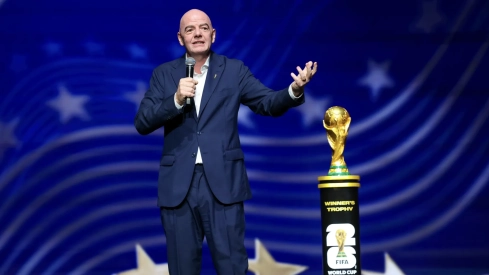
Gianni Infantino would have offered Morocco the 2030 World Cup final to retain its support in the race for the FIFA presidency. The information published this Wednesday by 'The Times' places the decisive match in the future Hassan II stadium in Casablanca, with a planned capacity for 115,000 spectators.
The alleged promise would allow Infantino to strengthen his position among the 54 African federations at a time when his candidacy for a fourth term is going through its most delicate moment. Morocco has become one of his strongest allies within international football and Rabat will host the next FIFA Congress.
The exclusive appeared while Infantino himself remains in Morocco. The leader gathered several of the organization's main officials in Rabat this Wednesday to try to contain a crisis that has already caused withdrawals of support, resignations, and criticism from his own executive team.
FIFA has responded by denying any agreement. "It is false and misleading to claim that the FIFA President has made any promise in relation to hosting the FIFA World Cup 2030 Final," a spokesperson said. The organization assures that it will make the decision "in due course".
Martyn Ziegler, the 'The Times' journalist who published the exclusive, has maintained his version after learning of the denial. "FIFA denies Infantino has made a promise about the 2030 final. The source stands by the information," he wrote on his X account.
FIFA denies Infantino has made promise around the 2030 final. Source stands by the information.
— Martyn Ziegler (@martynziegler) August 5, 2026
FIFA spokesperson: “It is false and misleading to claim the FIFA President has made any promise in relation to hosting the FIFA World Cup 2030 Final. A decision will be made by FIFA…
Spain, Portugal, and Morocco will jointly organize the 2030 World Cup, accompanied by three commemorative matches in Uruguay, Argentina, and Paraguay. The Spanish bid contributes eleven stadiums, compared to six Moroccan and three Portuguese, although FIFA reserved the choice of the final venue.
The Santiago Bernabéu has been the main favorite for months. The president of the RFEF, Rafael Louzán, has publicly defended that Spain will host the match and has pointed to Real Madrid's stadium as the first option. Morocco has simultaneously intensified its campaign around the Hassan II, a venue still under construction that aspires to become the largest football stadium in the world.
The choice of Casablanca would remove Spain from the most important match of a tournament in which it concentrates most of the venues. It would also confirm the weight gained by Rabat during Infantino's tenure, who has visited Morocco four times in the last two years and has promoted the opening of a regional FIFA office in the country.
Infantino seeks support after losing the backing of several federations
The alleged offer comes after the failure of the most controversial project of Infantino's presidency. The leader proposed selling 20% of a new company in charge of commercially exploiting the World Cup and other competitions to private investors. The operation provoked strong rejection within European football and forced FIFA to withdraw it last Friday.
The organization admitted that the initiative had generated divisions incompatible with its objectives. FIFA Secretary General, Mattias Grafström, internally described what happened as a succession of "sad and reprehensible" events, while Arsène Wenger assured that he learned about the project through the media and considered its withdrawal "absolutely necessary".
The wear and tear has also reached Infantino's political supporters. The federations of England, Wales, Finland, and Serbia have withdrawn the letters with which they supported his continuity, and other European federations are considering following the same path before the elections scheduled for March 18, 2027.
Luis Figo has joined that rebellion. The former Portuguese footballer has accused Infantino of degrading the FIFA presidency, lying, and trying to enrich himself at the expense of football. "It's too late to save his dignity, but it's not too late to save football. He should go. Now," he demanded.
The crisis took on a more serious dimension when Prince Ali bin Al Hussein, President of the Jordan Federation, accused Infantino's inner circle of using "blackmail" to gain support. According to his account, during the last World Cup, he was verbally informed that backing the leader would considerably help resolve his federation's pending problems.
"We did not support him before and we certainly will not do so now," Prince Ali responded after making the alleged pressure public. FIFA has also failed to close this new controversy while doubts grow about the methods employed by Infantino to rebuild his candidacy.
The president retains important allies outside of Europe and still lacks a declared rival. Morocco occupies a central position in this network of support, both for its influence within Africa and for the close relationship maintained with Infantino in recent years.
At the RFEF, they are confident that the Bernabéu will retain the final, although the movements between Infantino and Morocco have increased concern in Spain. FIFA still has not announced where the decisive match of the 2030 World Cup will be played.
