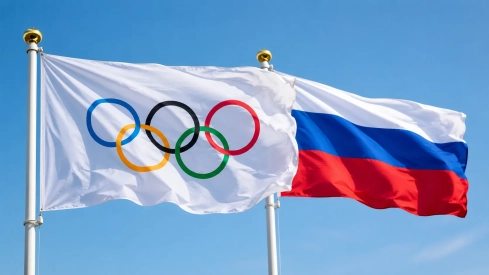
The International Olympic Committee has made a turn of enormous political and sporting weight. The Executive Board of the IOC has provisionally lifted the suspension of the Russian Olympic Committee, in effect since October 2023, and leaves the path open for Russian athletes to seek a place in the Los Angeles 2028 Olympic Games.
The decision does not imply a full and unconditional return, but it does break with the toughest stage of the Olympic veto on Russia. The IOC withdraws its recommendations to international federations regarding restrictions on Russian athletes and teams, applied after the invasion of Ukraine and later tightened due to the institutional conflict between Moscow and international Olympism. The organization leaves for later the decision on the Russian flag, anthem, colors, and symbols at the Games.
The IOC Executive Board has provisionally lifted the suspension of the Russian Olympic Committee. Recommendations to International Federations with regard to Russian athletes’ participation are no longer applicable.
— IOC MEDIA (@iocmedia) July 7, 2026
Read: https://t.co/k9FlApULU5 pic.twitter.com/K0pVQ7eJH1
The formal argument of the IOC concerns the Russian Olympic Committee. The suspension was imposed on October 12, 2023, because the ROC had incorporated regional sports organizations from occupied Ukrainian territories into its structure, something the IOC considered a violation of the Olympic Charter and the jurisdiction of the National Olympic Committee of Ukraine. Now, after the report from its Legal Affairs Commission, the organization maintains that these entities are no longer listed as members of the Russian committee.
The measure comes with the qualification period for Los Angeles 2028 already underway. The IOC argues that equal access to competitions must be guaranteed and transfers the management of the Russian return to international federations and organizers. This implies that each sport will have room to organize the return, although the political signal from Lausanne has already been sent.
From the veto after Ukraine to the gradual return
Russian Olympism had been in an anomalous situation for years. After the invasion of Ukraine in February 2022, the IOC recommended excluding Russian and Belarusian athletes and officials from international competitions. Later it allowed the return of some athletes as neutrals, without flag, without anthem and under control criteria regarding their relationship with the war.
In Paris 2024 and the Milan-Cortina 2026 Winter Games, Russians did not compete as a national delegation. They did so as individual neutral athletes, with political and sporting restrictions. That model is now being withdrawn for Russia, as already happened on May 7 with Belarus, when the IOC stopped recommending general limitations for its athletes.
The normalization, even so, does not erase the core of the conflict. The IOC itself insists that it maintains its condemnation of the Russian invasion of Ukraine and that it will continue to support the Ukrainian Olympic community through solidarity programs, logistical aid, sports equipment, and support for the international participation of its athletes. It also warns that it will continue to monitor any activity of the Russian Olympic Committee in territories under Ukrainian sports jurisdiction.
The organization will also not open the institutional door to Moscow. It will not organize its own events in Russia nor invite Russian government or state officials to its events. The display of national symbols in ordinary international competitions is left to each federation, but in the Olympic Games, the final word will be the IOC's.
Doping continues to weigh on Russia
The Russian return is not only explained by the war. The history of state doping also continues to weigh on Russian sport, which already shook the Sochi 2014 Games and led to years of sanctions, reinforced controls, and participation under alternative formulas. The IOC knows that this shadow has not disappeared and therefore links the return to specific anti-doping requirements.
Russian athletes returning to international competition must integrate into an anti-doping program delegated to the International Testing Agency. They will also have to pass multiple tests before returning, depending on the risk of each sport. If the World Anti-Doping Agency maintains RUSADA as a non-compliant organization before Los Angeles 2028, the IOC will commission the ITA for independent controls for all qualified Russians.
This condition tries to respond to the distrust of a large part of the international sports community. Russia is not only returning from a political sanction for Ukraine. It is also returning from a long crisis of competitive credibility that affected medals, federations, laboratories, manipulated data, and accumulated sanctions for more than a decade.
The decision has already been received in Moscow as a step towards full return. The Russian Minister of Sports, Mikhail Degtyarev, has celebrated that the IOC's move will accelerate the reintegration of its athletes into international competitions. In Ukraine, however, the reading will hardly be sporting. Russia's return comes with the war still open and with Ukrainian athletes training, competing, and rebuilding careers under the direct effects of the invasion.
Los Angeles 2028 will have Russia back on the Olympic path. What it still doesn't have is a Russian flag authorized to parade.
