Donald Trump has given a new turn to US policy on artificial intelligence. The President of the United States has ordered federal agencies to replace the expressions "artificial intelligence" and "AI" with "superintelligence" and "SI" in their official communications and documents, while reaching a voluntary agreement with the main technological giants to strengthen controls on the development of these systems.
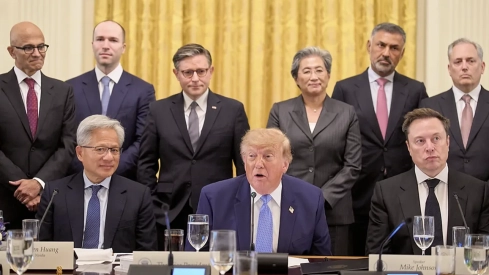
The decision comes after a meeting held at the White House with several of the sector's top executives. Trump has argued that current technology already goes far beyond the simple automation of certain human capabilities and has presented this new stage as a technological race in which the United States seeks to maintain its advantage over China.
The change in terminology is not limited to a political gesture. The White House already uses "super intelligence" in official documentation related to its new digital services, while the order also establishes a deadline to advance an official definition of the concept.
A voluntary agreement with four levels of control
The other major outcome of the meeting has been the commitment reached with some of the leading technology and artificial intelligence companies. Signatories include executives from companies such as Google, Meta, OpenAI, Nvidia, Anthropic, and xAI.
The pact proposes four levels of supervision. Companies must establish internal controls to assess the risks of their systems, have teams responsible for verifying that these measures are met, resort to independent external auditors, and create committees within their boards of directors to oversee the results of these evaluations:
- Internal security controls to identify and manage model risks, including those related to cybersecurity and biosecurity.
- Internal oversight teams responsible for verifying that these controls are applied.
- Independent external audits to evaluate the security measures adopted by the companies.
- Independent committees within the boards of directors to oversee the results of these evaluations.
The agreement does not constitute a new law nor does it establish legal obligations equivalent to a federal regulation. It is a voluntary commitment that Trump has defined as "morally binding" and that could serve, according to the document itself, as a basis for future laws or regulations.
Trump has precisely defended the self-regulation of the sector against the possibility of imposing new limits on the development of these systems. Before the meeting, the president had insisted that the United States should not slow down a technology that he considers strategic for its economy and its international position.
Some executives present at the meeting have, however, introduced a more cautious tone. Dario Amodei, from Anthropic, has warned that the technology poses "very real risks" and that the debate on how to address them is still open.
The pact also comes at a time of increasing pressure on companies due to the risks associated with the development of increasingly autonomous systems. Researchers and former employees of some of these companies have demanded greater safety guarantees given the speed with which technology is advancing.
The meeting also served to address another of the major conflicts accompanying the expansion of AI: the growth of data centers. Trump has defended their construction and has proposed that technology companies contribute financially to the communities in which they are installed or adopt measures aimed at reducing their impact on energy costs.
The president has presented the development of artificial intelligence as a strategic competition with China and has insisted that the United States must stay ahead. In parallel, his Administration has opted for a model that combines the promotion of technological expansion with voluntary security commitments assumed by the companies themselves.
The result is a new American strategy in which the word AI is even beginning to be relegated in official language, while the companies leading the sector directly assume a large part of the responsibility for the controls and audits of their own systems.