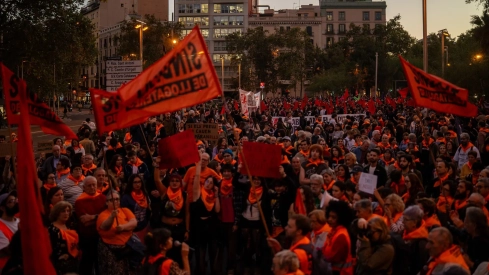
Barcelona takes to the streets again for housing, this time with the memory of Maricarmen and Olga at the center of the protest. "The housing business kills" is the slogan of the mobilization that gathers demonstrators this Friday afternoon in Plaça de la Universitat, called by the Sindicat de Llogateres, the Sindicat d’Habitatge Socialista de Catalunya, and the Confederació Sindical d’Habitatge de Catalunya (COSHAC). The PAH also joins the call. The tribute is accompanied by a demand to institutions and the real estate sector to stop evictions and a call for the general strike on November 11.
The concentration has grown since 7:00 p.m. and exceeds a thousand attendees according to a first estimate by 'El Periódico', still provisional and awaiting an official count. The protest occupies the Gran Via, where the Guàrdia Urbana has diverted traffic. RTVE reports that the demonstration is starting to move through the streets, while slogans such as "Maricarmen, we don't forget you" and "What's happening? What's happening? We don't have a home!" are heard.
En Barcelona, la manifestación por la vivienda comienza a circular por las calles. Denuncian que el negocio de la vivienda mata.
— RTVE Noticias (@rtvenoticias) October 9, 2026
🎙️ @annalladoferrer #Canal24Horas pic.twitter.com/BtkDxL378r
The memory of Maricarmen and Olga
A large wreath of flowers dedicated to the two women accompanies the headstone. Attendees observed a minute of silence that ended with loud applause and the chant of "Todos somos Maricarmen" (We are all Maricarmen), chanted in Catalan. Among the interventions, students took the floor to ask for unity and encourage support for the strike.
María del Carmen Abascal, Maricarmen, was 87 years old and was evicted on September 23 from her home in the Retiro neighborhood of Madrid, where she had lived for seven decades. Her death this week, after the eviction, has extended tributes and protests for access to housing. This Thursday, a march went through Madrid from Puerta del Sol to Alcalde Sainz de Baranda street, where her house was.
The call also remembers Olga, a 54-year-old resident of L'Hospitalet de Llobregat, who died by suicide on September 7 after having lost her home. The name of Javier, another resident of that city remembered by housing collectives, also appears in the messages of support. The Student Union states on its networks that there are "thousands" in Barcelona and warns that they will not tolerate "one more eviction."
Por Maricarmen, Olga, Javier y todas las víctimas de este sistema capitalista criminal.
— Sindicato de Estudiantes (@SindicaEstudian) October 9, 2026
Somos miles en Barcelona bajo el mismo clamor: no vamos a tolerar ni un desahucio más. pic.twitter.com/gRePWsBYy5
Towards the November 11 strike
Carme Arcarazo, spokesperson for the Sindicat de Llogateres, calls to paralyze the country on November 11. "We are at a historic point where we can turn the history of this country around, we can finally make housing a right and end the real estate business," she states to the media at the beginning of the protest, in statements collected by Europa Press.
The demands include the end of evictions, indefinite contracts, the prohibition of speculative purchases, and a wealth tax that allows for a substantial expansion of public housing. Arcarazo directs the protest against real estate employers, investment funds, and large landlords, but also against the political class. She reproaches the Government for "dragging its feet for eight years and blocking serious measures that could have prevented what happened to Maricarmen."
Gisela Bermúdez, spokesperson for the Sindicat d’Habitatge Socialista de Catalunya, links the mobilization to the deterioration of wages and living conditions over the last decade. She describes a "historic setback" that leaves more and more workers struggling to make ends meet. "Enough is enough. The working class must go on the offensive," she maintains, and accuses politicians of both left and right of siding with landlords.
Marta Espriu, spokesperson for COSHAC, advocates for union organization as a way to demand housing rights. She also recalls the block on Llenguadoc street, acquired by the City Council and the Generalitat, and reproaches the mayor of Barcelona, Jaume Collboni, for claiming a victory that she considers the result of popular mobilization. "We will not ask for anything, we will demand that our rights be fulfilled and that it be done according to our own criteria," she states.
