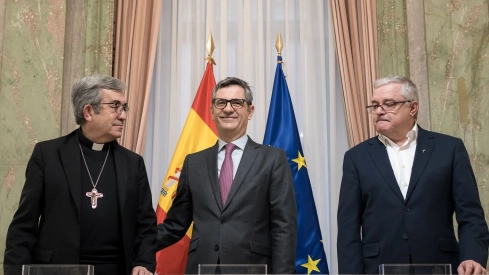
The Government and the Spanish Episcopal Conference will sign this Monday at 11:00 hours at the headquarters of the Ombudsman the Protocol for the organization and operation of the system for the recognition and reparation of victims of sexual abuse within the scope of the Catholic Church, an agreement that will allow to compensate victims whose cases have prescribed and cannot be judicially prosecuted.
The document will be signed in the presence of the Minister of the Presidency, Justice and Relations with the Cortes, Félix Bolaños; the president of the Episcopal Conference, Luis Argüello; the president of the Spanish Conference of Religious, Jesús Díaz Sariego; and the Ombudsman, Ángel Gabilondo.
The protocol articulates an extrajudicial reparation system that will allow victims to access economic compensation, institutional recognition of the harm and psychological support. This mechanism seeks to offer an alternative given the impossibility of resorting to the criminal justice system due to the statute of limitations on the crimes.
Executive sources indicate that the agreement responds to a “moral obligation of the State” and aims to “place victims at the center” of the institutional response. Along these lines, they highlight that the system not only includes compensation, but also public recognition of the suffering endured.
From the Church, sources from the Episcopal Conference emphasize that the protocol represents “a significant step in the commitment to reparation” and in the attention to victims, in a context of growing social demand.
The agreement is framed within the scenario opened after the report of the Ombudsman, presented in October 2023, which highlighted the magnitude of the abuses in the ecclesiastical sphere and the need for reparation mechanisms beyond the judicial route.
The system will be voluntary and will allow victims to avail themselves of a process of recognition and compensation whose development will be specified in later phases, with the participation of independent experts.
Although the protocol does not imply criminal responsibilities, it does establish a framework of restorative justice based on the recognition of the harm caused and the institutional response. Victims' associations have valued the progress, although they demand transparency and clear criteria in its application.
Add ElConstitucional.es as a preferred Google source for free.
Stay informed about all the latest breaking news with the best information. Against disinformation, for democracy and social rights.
