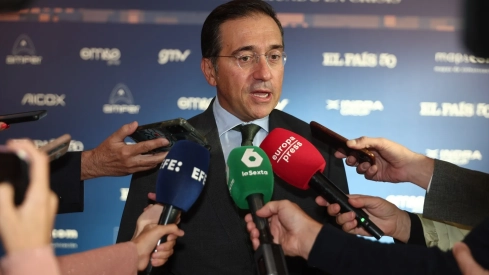
The Government has opened a path of understanding with the presidents of Ceuta and Melilla, the 'popular' Juan Jesús Vivas and Juan José Imbroda, regarding its plan to reinforce the weight of the two autonomous cities within the European Union. The Minister of Foreign Affairs, European Union and Cooperation, José Manuel Albares, assured this Thursday that he found "harmony" in both leaders during the conversations held on Wednesday.
The call introduces a different tone after several weeks of political clashes, especially between the Executive and the Ceuta Government, over the care of migrants, temporary accommodation in the port, and the proposal to transfer 500 especially vulnerable minors to the Peninsula.
Albares wanted to present the measures to Vivas and Imbroda before the package is formally transferred to European institutions. The proposal was presented on Tuesday before the Council of Ministers and includes the work developed by several departments after the contacts maintained by the head of Spanish diplomacy in Brussels.
“They agreed with what I proposed to them,” Albares explained. The minister has now asked for unity from political forces to promote an initiative that, he maintains, has possibilities of advancing quickly within the European Union.
The initial understanding is also important due to Vivas and Imbroda's membership in the Popular Party. The Government seeks for the European integration of Ceuta and Melilla to become a position shared by the main political forces and to remain outside the open confrontation during the management of the migration crisis.
More political, border, and economic presence
The plan contemplates that Ceuta and Melilla have permanent representation in the European Committee of the Regions, the advisory body in which regional and local representatives from the 27 member states participate. Spain currently has 21 seats, 17 of them allocated to autonomous communities and four to local entities.
The Government also wants to complete the entry of the two cities into the European Customs Union, preserving their geographical, fiscal, and commercial particularities. The measure would reinforce their economic integration into the community space and would require adapting a regime historically marked by their location in North Africa.
The third leg involves consolidating a permanent institutional presence of the European Border and Coast Guard Agency (Frontex). The Executive intends for the protection of Ceuta and Melilla to no longer be addressed solely as a Spanish responsibility and to become a stable part of European border policy.
These measures will be supplemented by a specific political and financial package that recognizes the difficulties arising from their location. Albares has described the area as “the most unequal border on the planet” due to the enormous economic distance between both sides.
“Ceuta and Melilla are Spain, but they are also the European Union,” the minister defended. His intention is to place the two cities “at the heart of Europe” and achieve for the southern border a degree of attention comparable to that received by countries located on the eastern flank.
Albares calls for overcoming recent clashes
The minister took advantage of the rapprochement with Vivas and Imbroda to demand cooperation in the face of problems that still hinder the return to normality. The National Court had preventively halted the installation of a camp intended to house migrants in the port of Ceuta, a decision that has introduced another obstacle in the plan prepared by the Government.
“If a problem is raised for every solution, we are going to excessively prolong the return to normality,” Albares warned. The Foreign Minister summarized his position with a request addressed to all involved administrations. “For every problem a solution, not for every solution a problem.”
The Government maintains that during the first 48 hours it achieved the return of 90% of the people who entered Ceuta irregularly at the end of July. Procedures continue for those who remain in the city, with the commitment to respect the guarantees provided in Spanish and European legislation.
Albares has also linked the protection of the autonomous cities with the growing instability of the Sahel, a region that has become one of the main hotbeds of international terrorism. The minister recalled that Bamako is about 3,000 kilometers from Madrid, a shorter distance than that separating the Spanish capital from Moscow.
The Executive's foreign strategy combines border reinforcement with cooperation in countries of origin and transit. Albares maintains that acting on poverty, violence, and lack of opportunities is essential to reduce forced displacement. According to data presented by the minister, irregular arrivals via the Western Mediterranean and the Atlantic have decreased by 29% during the first months of the year.
Add ElConstitucional.es as a preferred Google source for free.
Stay informed about all the latest breaking news with the best information. Against disinformation, for democracy and social rights.
