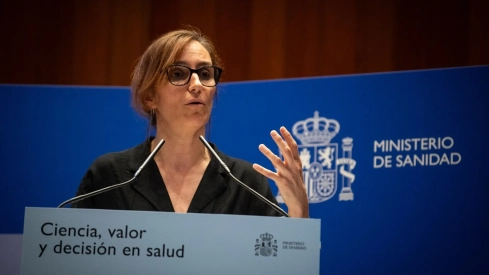
The Healthcare Framework Statute once again leaves Mónica García facing a complete autonomous front. The heads of Human Resources of the 17 autonomous communities have signed this Thursday a common decalogue to demand that the Ministry of Health renegotiate the text and do so with institutional consensus, technical evaluation, and an economic report capable of measuring the real cost of the reform.
The reading of the document took place in the Ministry's Technical Delegated Commission for Human Resources, on the eve of a new Interterritorial Council of the National Health System. The autonomous position comes after months of tension with doctors, strikes spread across different territories, and a discomfort that the Ministry of Health has not managed to close despite the agreement reached in January with the unions of the Negotiation Area.
The communities do not question the need to update a regulation that dates back to 2003 and regulates the conditions of statutory personnel in health services. The clash is in how the reform has been constructed and who will have to apply it. Hospitals, health centers, staff, on-call duties, breaks, substitutions, remuneration, and daily planning practically depend on the autonomous health services.
The consensus demanded by the autonomous communities
The decalogue speaks of a "serious, realistic, viable, consensual, and adapted" reform to the real functioning of the health system. The communities argue that any change of this caliber must be developed with the ordinary coordination bodies of the National Health System and with the Human Resources Commission as the central working space.
The reproach is clear. The autonomous communities consider that the latest versions of the preliminary draft have not had sufficient inter-administrative cooperation and that a large part of the modifications incorporated at the end of the negotiation respond more to union dialogue than to the analysis of those who manage public health services.
The Ministry argues that the new Framework Statute includes historical labor improvements, such as the end of 24-hour on-call duties as a general rule, a maximum weekly working day of 45 hours, advances in work-life balance, limits on temporary employment, and a new professional classification. The Ministry of Health maintains that the text stems from social dialogue and seeks to strengthen public healthcare.
The communities accept that general objective, but ask for guarantees before moving such sensitive pieces. Their position is that improving labor rights requires calculating how many professionals will be needed, how much it will cost to reorganize shifts, and how healthcare will be protected 24 hours a day.
On-call duties, working hours, and staff
The heart of the conflict lies in working conditions. The reform touches on on-call duties, breaks, working hours, professional classification, supplementary remuneration, dedication, and staff planning. Each point has a direct translation in hospitals.
The reduction of 24-hour on-call shifts, one of the Ministry's big banners, has social support that is easy to understand. Few dispute that such long working hours are difficult to defend in the 21st century. The problem arises when converting this improvement into a norm applicable to the entire territory without having the necessary staff closed to cover gaps, especially in strained specialties, rural areas, and services with a structural deficit of professionals.
That's where the communities hold on. They demand a prior organizational and budgetary impact assessment because any reduction in working hours or change in breaks forces them to redo shifts, hire more staff, or assume overloads in services that are already operating at their limit. They also warn of the risk of increasing legal conflict if the text is approved without a solid technical basis.
The medical front adds another layer to the conflict. Medical organizations have been demanding their own framework for months or, at least, a specific negotiation that includes their unique conditions. Among their demands are the voluntary nature of on-call duties, better remuneration, adequate recognition of training and professional career, and a regulation that does not dilute their demands within the entire healthcare staff.
Political pressure on Mónica García
The autonomous unity has political weight because it is not limited to communities governed by the PP. The document is signed by the Human Resources managers of all regions and reinforces the position that the Health Councilors had already expressed in recent weeks. The Community of Madrid has raised the tone and maintains that the minister "has been left alone," although the common text avoids turning the decalogue into a simple partisan amendment.
The communities' proposal leaves an open path. They do not ask to renounce the reform, but rather to return the text to the working group for updating the Framework Statute created in 2023, review its impact, and rebuild the agreement with the administrations that will have to apply it. They also demand a complete economic report and adequate funding so that the new rights do not remain a declaration difficult to execute.
Healthcare thus arrives at the Interterritorial Council with a reform that has not yet managed to organize all the actors. The Ministry has the support of the unions that signed the initial agreement, but maintains an open conflict with doctors and with the communities. Legislative processing can advance, although the political and care cost of doing so without rebuilding consensus is beginning to be increasingly high.
The Interterritorial Council will measure the real margin for agreement
The Interterritorial Council will be the next scenario of the crisis. On the table will be the Framework Statute and other health matters, but the underlying struggle will be the capacity of Healthcare to redirect a reform that was born as a historic labor improvement and has ended up becoming one of the biggest clashes of Mónica García's mandate.
The communities arrive with a common message: they want to participate in the final wording, calculate the cost of the measures, and guarantee that hospitals and health centers can sustain care. The Ministry will now have to decide whether to maintain the planned schedule or accept returning the text to a longer negotiation, with the counselors, personnel managers, and healthcare professionals back at the table.
Add ElConstitucional.es as a preferred Google source for free.
Stay informed about all the latest breaking news with the best information. Against disinformation, for democracy and social rights.
