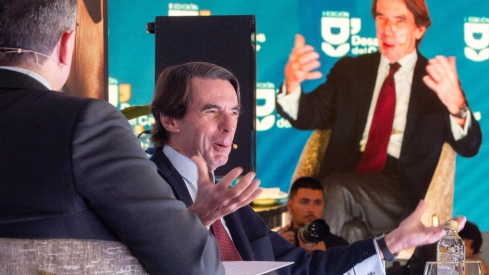
José María Aznar has once again placed the unity of Spain at the center of the 29N campaign. Three days before the general elections, the former President of the Government has maintained that Pedro Sánchez could recognize Catalonia as a nation if he again needs the support of the independentistas to govern. "It depends on how many votes he needs," he said this Thursday during a dialogue with journalist Álvaro Nieto at the second gala of Desayunos del Campo, held at the Palace Hotel in Madrid.
Aznar has accused Sánchez of having "bought" his continuity in La Moncloa with the amnesty and has presented plurinationality as the next demand of his partners. "The Spanish nation is over, this is a confederation of different nations," he stated when describing that scenario. His words come a day after the leader of Junts, Carles Puigdemont, announced his return to Catalonia for December 12, after his case was archived in the Supreme Court by applying the amnesty.
Aznar's hypothesis goes beyond what can be decided in an investiture. Article 2 of the Constitution establishes the unity of the Spanish nation and recognizes the right to autonomy of nationalities and regions. Changing that article to implement a confederal model would require a constitutional reform with two-thirds majorities in Congress and the Senate, new elections, another vote in both Chambers, and a referendum.
Aznar recalls his 1996 pacts when talking about the far-right Vox
Asked about the possibility that Alberto Núñez Feijóo might need the far-right Vox to govern, Aznar said that this scenario does not worry him. To explain it, he referred to his own arrival at La Moncloa. In 1996, the PP won the elections with 156 seats and Aznar was invested with 181 votes thanks to the support of Convergència i Unió, the Basque Nationalist Party, and Coalición Canaria. Sánchez obtained 179 votes in 2023, including those of Junts and EH Bildu, two of the formations against which the former president lashed out this Thursday.
Aznar did diverge from Feijóo on another campaign issue. After the controversy over the "cardboard ballot boxes" and the vote of those naturalized by the so-called 'grandchildren law', the former president defended that the Spanish electoral system has sufficient guarantees, although he questioned the criteria for granting nationality. The Central Electoral Board rejected on Monday the claims about alleged irregularities in the external vote due to lack of evidence.
Aznar says he would have militarized Ceuta
The former president also criticized the Government's response to the entry of migrants into Ceuta on July 30 and 31. He stated that he would have ordered the militarization of the city and even questioned whether the Executive's actions were due to "its ineptitude or its complicity with what happened." He also questioned Sánchez's shift on Western Sahara, after the Spanish Government backed the Moroccan autonomy proposal as a basis for resolving the conflict in 2022.
The Audiencia Nacional continues to investigate what information the authorities handled before the entries. This Thursday, the Spanish consul in Tetouan, Fernando Villalonga, testified as a witness that he warned the ambassador in Rabat that the border was "hot," after receiving information about a greater presence of people in the area. Judge María Tardón announced that she would request those warnings.
In the part of the meeting dedicated to the countryside, Aznar revived the demand for the Ebro transfer, which was included in his Government's National Hydrological Plan. "We have lost 25 years," he said, regretting the repeal of the project. He also supported Feijóo's commitment to promote a national water pact if he reaches La Moncloa.
Contact
We are listening. Get in touch.
