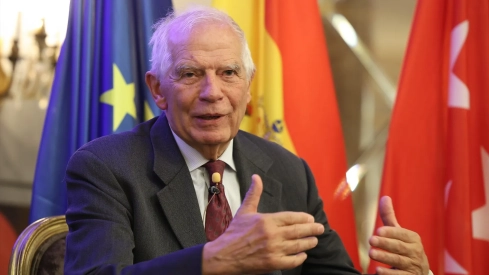
Josep Borrell has lashed out this Tuesday against the initial response of several European partners to the migratory crisis in Ceuta. The former head of community diplomacy considers that Spain suffered a "hybrid attack" and accuses some governments of using what happened to defend their electoral interests.
"It causes me great frustration to see how European solidarity has died in Ceuta," he said in an interview on 'Hoy por Hoy', on 'Cadena SER'. Borrell has especially pointed to Italy for having "set fire to the fuse" by proposing Spain's expulsion from the Schengen area.
The statements came just hours before the extraordinary videoconference of the Interior Ministers of the European Union. The meeting was requested by 22 countries, led by Italy and Denmark, after 72,000 people crossed the border from Morocco during last week's crisis.
Borrell has reproached these governments for directing their criticism against "the country that has suffered a hybrid attack." The socialist politician has appreciated that France, Portugal and Ireland distanced themselves from the letter promoted against Spain and has asked the Government to demand the same support provided during other migratory and territorial crises.
"Spain has to raise its voice in the Council," he defended. The former High Representative recalled Spanish support for Denmark against Donald Trump's claims over Greenland and the participation of the Armed Forces on NATO's eastern flank. "Populist demagoguery" cannot take the place of the Rule of Law and European solidarity, he warned.
Borrell has also called for prudence with Morocco. Although he has linked the massive entry with the use of desperate people as an instrument of pressure, he considers it essential to maintain cooperation with Rabat. The immediate priority, he insisted, must be to attend to those who remain in Ceuta, including minors who still need assistance.
Brussels changes its tone after the meeting
The meeting of the Interior Ministers has considerably reduced the open confrontation during the last few days. After almost four hours of talks, the European Commissioner Magnus Brunner assured that there was "total solidarity with Spain around the table" and that the governments recognized Madrid's "immediate and efficient" response.
The Minister of Interior, Fernando Grande-Marlaska, has described the meeting as "constructive" and has reported that 70,000 of the 72,000 people who entered Ceuta have already returned to Morocco. He also defended that the Schengen area was never compromised because the newcomers did not advance towards the Peninsula or other European countries.
Brunner has also admitted that Brussels lacks evidence to establish a direct relationship between the extraordinary regularization promoted by Spain and the massive entry into Ceuta. The commissioner maintains his criticism of the measure, which he considers a bad signal for other partners, but has acknowledged that this issue barely provoked reproaches during the meeting.
The ministers have agreed to strengthen the fight against human trafficking networks, accelerate returns, improve the protection of external borders, and expand cooperation with third countries. They have also called for more prior intelligence, social media monitoring, and early warning systems capable of anticipating a new massive entry.
Italy has finally expressed its "sincere solidarity" with Spain, although it will maintain selective controls for one month on non-EU travelers from Spanish airports and ports. Rome argues that the measure is preventive. The threat of removing Spain from Schengen has disappeared from the conclusions of the Twenty-Seven.
