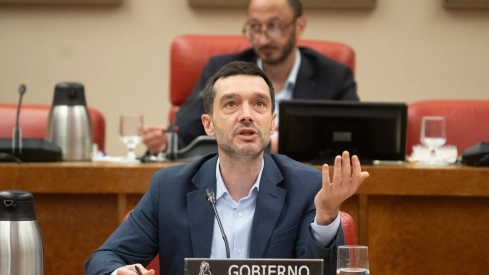
The Minister of Social Rights, Consumer Affairs and Agenda 2030, and campaign spokesperson for the Frente Amplio, Pablo Bustinduy, has placed the electoral debates as the decisive stretch of the campaign for the elections on November 29, and has assured, in an interview on 'Hoy por Hoy' with Aimar Bretos, that this face-to-face will serve to confront “two models”.
According to him, the weight of this exchange will not only depend on the proposals presented, but also on the absences, in a scenario where, in his opinion, “the key to what happens is held by Vox and the Frente Amplio”.
Reduces the impact of polls
Given polls that paint a complicated picture for progressive forces, Pablo Bustinduy has downplayed the surveys and argued that they can be wrong again. “Polls have always underestimated the left,” he said, before adding that, if working people turn out to vote, “we are going to make the polls fail again.”
The leader of the Frente Amplio has also claimed the influence of his political space within the left and has criticized the PSOE, which he has accused of having first rejected several of its proposals only to later incorporate them into its electoral program. “It is an objective fact that the four main battles we have elaborated and presented were rejected by them and now they have included them in their electoral program,” he pointed out.
Housing, one of the main topics of the interview
A good part of the conversation has revolved around housing, one of the central issues of the campaign. Pablo Bustinduy has presented the Frente Amplio's proposal to oblige that homes exceeding a fourth property be allocated to affordable rent or, otherwise, face a new tax burden. According to his calculations, the measure would allow mobilizing 1.3 million homes.
The minister has also defended the extension of rental contracts promoted by his political group, and has assured that it represents an average saving of 4,000 euros per household, a figure that, as he explained, rises to 10,000 euros in Madrid and other large cities.
Criticism of Vox, Feijóo and the employers' association
Asked about Santiago Abascal's attacks on him, the campaign spokesperson for the Frente Amplio acknowledged that “Abascal has gotten annoyed,” and anticipated his strategy of confrontation with the far-right: “But I am going to dedicate myself to telling workers that Vox is the political arm of the employers' association.”
Along the same lines, Pablo Bustinduy has accused Vox of voting against social measures that benefit its own voters, such as the social bonus, and has insisted that he will take every opportunity to denounce it: “I will take every chance I get to tell them they are hypocrites.”
The minister has also directed his criticism towards the president of the Popular Party, Alberto Núñez Feijóo, whose program he considers increasingly close to that of Vox. “Feijóo's program is increasingly similar to Abascal's. It's about taking everything away,” he stated.
Defense of political action and final optimism
Beyond partisan struggle, Pablo Bustinduy has defended the usefulness of political action and has stressed that citizens not only value the possibility of stopping the far-right, but also concrete advances in social and labor rights. “Politics is stark and this 'anything goes' attitude has taken hold. But the important thing is to do it,” he said.
The minister also claimed the management carried out during the legislature against “very powerful adversaries,” and directly pointed to the employers' association and the PP in debates such as that of the minimum wage. Despite this scenario, he showed optimism for 29-N: “People on the left are very aware of what is at stake, I believe they will go to vote and I believe there will be a left-wing government in the next legislature.”
Contact
We are listening. Get in touch.
