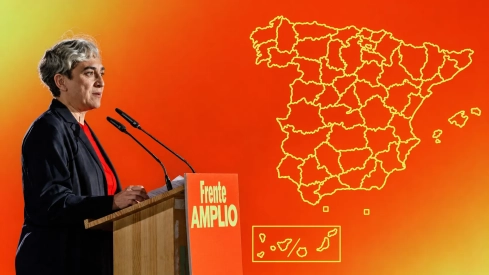
Frente Amplio has taken the dispute over the "useful vote" to the provinces where the last deputies of 29N will be decided this Wednesday. The candidacy led by Ada Colau identifies 17 priority constituencies and argues that strengthening its lists would allow it to snatch representation from the PP and the far-right Vox while maintaining the PSOE's seats. With this argument, it tries to stop the concentration of the progressive vote on Pedro Sánchez and defend its ability to contribute to a left-wing majority.
The coalition places some of these deputies a few tenths of a point away. Asturias and Las Palmas appear among the tightest cases, according to its calculations on the pre-electoral study by the Center for Sociological Research (CIS). In other provinces, the necessary growth would be considerably greater. The differences managed by the candidacy describe different opportunities, from retaining a threatened representative to obtaining a second deputy.
The move responds to a specific electoral difficulty. Frente Amplio needs to regain support after the division of the space that ran with Sumar in 2023 and convince its former voters that their ballot can be decisive. The PSOE seeks to gather the greatest possible support against PP and Vox, while Colau tries to demonstrate that an alternative left with representation can also prevent the right from reaching 176 deputies.
The 17 provinces and the seven clashes pointed out by Colau
Frente Amplio's priority map includes A Coruña, Alicante, Asturias, Balearic Islands, Barcelona, Córdoba, Granada, Las Palmas, Madrid, Málaga, Navarra, Bizkaia, Pontevedra, Santa Cruz de Tenerife, Seville, Tarragona, and Zaragoza. The candidacy aims to exceed 10% to expand its representation, although the percentage needed to obtain a deputy changes in each constituency.
Within this strategy, the space identifies seven specific confrontations with PP and Vox, including Castellón, which is outside the list of 17 priority provinces. Four of these clashes would be directly with Santiago Abascal's party. These are the margins that Frente Amplio calculates based on the CIS:
- Asturias. Places the necessary growth to snatch the last deputy from the PP at two tenths of a point.
- Las Palmas. Unidad del Pueblo Canario would retain a representative by a four-tenths advantage over Vox.
- Seville. Estimates that an additional point would allow the popular party to gain a seat.
- Madrid. A growth of 1.5 points would give Frente Amplio one more deputy at the expense of the PP.
- Castellón. Compromís–Front Valencià would be 1.9 points away from taking a representative from Vox.
- Alicante. The Valencian candidacy places the possibility of obtaining a second deputy at the expense of the far-right at 2.9 points.
- Córdoba. Frente Amplio estimates it would need to grow 3.7 points to secure a seat it attributes to Vox.
Las Palmas concentrates the coalition's defensive argument. According to their calculations, a loss of support to another candidacy could leave the Unidad del Pueblo Canario deputy in the hands of the far-right. In Asturias, however, Frente Amplio raises the possibility of incorporating a representative that its scenario attributes to the PP.
The origin of these supports also matters. Mobilizing a person who intended to abstain increases the bloc's vote, while a transfer between left-wing candidacies modifies their distribution. For this exchange to allow gaining a deputy from the right and maintaining those of the PSOE, the receiving list must reach the next seat and the socialist one must retain enough support to keep theirs.
Territorial alliances add another difference. In the Valencian Community and the Canary Islands, the shared candidacies incorporate Podemos, which competes with Frente Amplio in a large part of Spain. Fragmentation has a different intensity depending on the territory. In Andalusia, furthermore, the presence of Adelante Andalucía introduces a third candidacy to the left of the PSOE, especially relevant in provinces like Córdoba.
Polls disagree on the majority of PP and the far-right Vox
The latest polls offer very different scenarios for this fight. 40dB., Sigma Dos, Sondaxe, and GAD3 place the PP ahead, while SW Demoscopia and the CIS give the first position to the PSOE. The distance between some studies and others affects both the expectation of government and the deputies that each candidacy can dispute.
- 40dB., published on November 18: PP, 32.2%. PSOE, 30.7%. Vox, 17.0%.
- Sondaxe, published on November 18: PP, 29.0%. PSOE, 27.0%. Vox, 19.4%.
- SW Demoscopia, published on November 17: PSOE, 31.9%. PP, 28.9%. Vox, 16.5%.
- Sigma Dos, published on November 17: PP, 30.7%. PSOE, 26.4%. Vox, 19.8%.
- CIS, published on November 12: PSOE, 33.3%. PP, 25.5%. Vox, 18.4%.
- GAD3, published on November 9: PP, 32.0%. PSOE, 26.0%. Vox, 19.0%.
The publication dates correspond to different field work. The 40dB. survey includes interviews from November 13 to 17. Sigma Dos's survey goes up to the 16th, as does Sondaxe's. The CIS interviewed 45,074 people between October 7 and 30, while GAD3's national study collected responses from November 3 to 5.
The parliamentary difference is considerable. 40dB. projects 131 deputies for the PP and 55 for Vox, in addition to two for UPN-PP. Sondaxe attributes 121 to the PP and 71 to Vox. In both cases, these candidacies exceed the absolute majority. The latest SW Demoscopia survey places the PP at 118 and Vox at 54, a total of 172 representatives. GAD3 estimated 136 for the popular party and 63 for the far-right.
To compare Frente Amplio, it is necessary to check which coalitions each figure includes. For example, 40dB. separates 3.5% for Frente Amplio and 1.7% for its territorial alliances, which total 5.2%. Podemos is listed separately with 1.2%. This separation changes the reading compared to studies that group territorial candidacies.
The diversity of scenarios conditions the campaign. With a right-wing above 190 seats, recovering seven or eight deputies would constitute insufficient progress to change the majority on its own. In a Congress close to 176, those same representatives can decide the investiture. Frente Amplio's ability to expand the bloc also depends on the results of the PSOE and the territorial forces.
The last seat changes the calculations of the useful vote
The tactical voting model built with 20,000 simulations and surveys published up to November 16 places the PSOE as the only left-wing candidacy capable of moving seats in 23 provinces. In Madrid, Barcelona, Valencia, and Seville, it finds small differences between the main lists of the bloc. It also points to opportunities for the BNG in Lugo and Ourense, Adelante Andalucía in Córdoba, and Unidad del Pueblo Canario in Santa Cruz de Tenerife.
That map and Colau's 17 priority provinces respond to different exercises. Frente Amplio selects territories where it intends to grow and modify the distribution. A simulation calculates probabilities with the support estimated by the polls. A candidacy can aspire to a deputy who still appears far off in the average, and a difference of two tenths within a projection is exposed to the margin of uncertainty of the surveys.
In addition, territorial forces intervene in the calculation. In Galicia, an advance by the BNG can dispute the last deputy with the right. In Euskadi or Navarra, EH Bildu and the PNV also come into play, with different positions regarding an investiture. The parliamentary majority is built with provincial results and subsequent agreements, which forces us to look beyond the pulse between Sánchez and Colau.
Frente Amplio seeks to accompany this numerical argument with a political justification. Their criticisms of the PSOE for time tracking or the universal childcare benefit aim to demonstrate that the strength of their group conditions the measures of a future Government. The socialist campaign, for its part, tries to turn the possibility of a PP and Vox majority into an incentive to concentrate support on Sánchez.
The discussion about 10% also requires precision. The Organic Law of the General Electoral Regime establishes a barrier of 3% of valid votes in each constituency to participate in the distribution of the Congress. Then the number of deputies and the quotients of the D'Hondt method intervene, which divides the votes of each candidacy by one, two, three and successive divisors to allocate the seats.
An example allows us to verify Frente Amplio's argument. In a province with eight deputies, with PP at 35%, PSOE at 31%, Vox at 15% and Frente Amplio at 6%, the distribution among these four candidacies would be four, three, one and zero, respectively. The assumption requires that the remaining lists fall below the necessary quotient to obtain representation.
If four points go from PSOE to Frente Amplio, both would be at 27% and 10%. The PP would drop to three deputies, the PSOE would retain three, Vox would maintain one and Frente Amplio would get another. The left would obtain four representatives with the same 37% of the votes that previously provided three.
The size of the constituency even modifies that example. With seven deputies, the initial percentages would give three to the PP, three to the PSOE, and one to Vox. After the same four-point shift, the PP would retain three, the PSOE would drop to two, Vox would maintain one, and Frente Amplio would obtain one. The left would still have three representatives.
Contact
We are listening. Get in touch.
