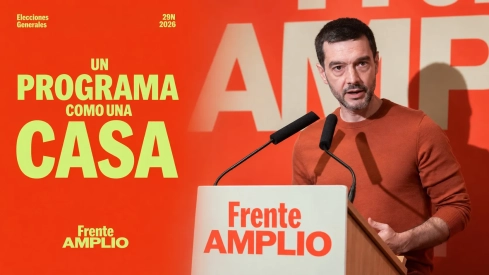
The Broad Front proposes to dedicate 1% of GDP each year to expand the public housing stock, progressively reduce the workday to 32 hours per week without salary reduction, and tax 100% of the portion of inheritances that exceeds 10 million euros per beneficiary. These are three of the measures with which Ada Colau's coalition is running in the general elections on 29N and which it would bring to the negotiation of a potential progressive government.
The program dedicates 18 chapters to explaining how it would translate this agenda into a legislature. In housing, it combines an investment that would take years to expand the supply with measures aimed at alleviating household expenses sooner. In labor, in addition to shortening the workday, it proposes that staff have a voice on boards of directors and participate in profits. This last proposal, less visible in the campaign, would change who intervenes in decisions such as the closure or relocation of a company.
Rents linked to neighborhood income and public housing from the first year
The Broad Front estimates that 1% of GDP is equivalent to about 17,000 million euros per year and would allow the incorporation of 125,000 public homes annually, reaching 1.5 million in twelve years. The figure includes construction, purchase, recovery of empty properties, and expropriations. For a typical public apartment of 80 square meters, the rent would have a maximum of 600 euros per month and would be adjusted so that it does not exceed 25% of household income. The scale of the plan is evident in the latest annual report from the Bank of Spain. Between 2021 and 2025, about 750,000 fewer homes were completed than households created.
In the private rental of stressed areas, the cap would be the lower of two figures: 25% of the average net income of households in the census section or the limit set by the state index. The program adds a 30% reduction on the regulated price in municipalities with more than 200,000 inhabitants or with severe tourist overcrowding and would make the indefinite contract the default modality. The declaration of a stressed area would be automatic if the legal requirements are met. If a community refused to process it, the Ministry of Housing could act ex officio or at the request of the city council.
To mobilize already built housing, the coalition proposes to expropriate in three phases properties from large corporate owners. It would start with those who own more than 1,000 homes, continue with those who own more than 700, and end with companies with more than 50. It also proposes a 10% tax on the value of apartments, with an exemption for those intended for affordable and stable rent. It would apply to companies from the first property and to individuals from the fourth when their properties jointly exceed 800,000 euros. In stressed areas, it plans to withdraw licenses for tourist apartments in residential buildings.
The chapter also includes a permanent ban on evicting vulnerable households without a housing alternative. Large landlords would have to offer them a social rent of at least seven years before going to court to claim payment or eviction. For small private owners, the Administration would assume the payment of rent at the index price while an alternative is provided. The coalition also wants to elevate housing to a fundamental right through a reform of article 47 of the Constitution.
Fewer working hours, 200 euros per child, and more taxes on large fortunes
The first step towards 32 hours a week would be to implement 37.5 hours and set the working day for public employees at 35. The Workers' Statute maintains the general maximum at 40 hours per week on an annual average, and Congress already returned the 37.5-hour project in 2025 after amendments from the PP, Vox, and Junts succeeded. The Frente Amplio revives that battle and adds a legal floor for the minimum wage of 60% of the net average wage. For pensions, it proposes to enshrine in the Constitution the increase with the CPI, equate the minimum to the minimum wage, and return the ordinary retirement age to 65 years.
The universal benefit of 200 euros per month per child would first reach households with children up to six years old, would be extended up to twelve in the second year, and would cover all minors under 18 at the end of the term. The Treasury would pay it automatically, regardless of the income or employment status of their parents. In 2025, 33.9% of children under 16 were at risk of poverty or social exclusion in Spain, according to the INE. The coalition adds free school meals to the aid and proposes setting maximum prices on basic foods when there is an emergency or abuse is proven.
Funding involves taxing wealth more and alleviating the personal income tax (IRPF) on earned income up to 27,000 euros. The tax text includes two distinct measures on inheritances. One is a complementary state tax for transfers exceeding one million net euros per beneficiary, which would deduct what was paid to the autonomous community. The other is the 100% marginal rate in Inheritance Tax for the portion exceeding 10 million per heir, counting donations received during life. The revenue from another tax, an effective minimum of 3% for assets starting from 50 million, would be allocated to the child-rearing benefit. For large business groups, the program sets an effective minimum of 20% in Corporate Tax on the adjusted accounting result.
In public healthcare, the goal is to dedicate 8% of GDP and reserve a quarter of the healthcare budget for primary care. The coalition wants to expand dental, visual, auditory, and mental health coverage and prioritize direct public management. It also sets a floor for educational spending of 7% of GDP by 2030, with more public places for zero to three-year-olds and fewer students per classroom. For the same year, it wants to raise spending on dependency to 1.7% of GDP. In culture, it proposes setting a minimum investment by law and extending the network of public libraries.
Renewables with public participation and more power for workforces
The coalition proposes dedicating 3.5% of annual GDP to ecological transition, from adaptation to heat and floods to industrial decarbonization. Its energy fund would enter with a 30% public stake in new small and medium-sized renewable and storage projects. Half of the profits would return to the fund, and the rest would finance public housing, rehabilitation, and pensions. Before 2030, neighborhood communities with suitable rooftops would have to install self-consumption solar panels. The State would advance the cost, and residents would repay it without interest with part of the savings on their bill.
In transport, the program aims to extend the state pass to urban and regional networks and includes a combined flat rate of 50 euros per month. The current general pass costs 60 euros. For railways, the Broad Front proposes integrating Renfe and Adif into a public operator and recovering public operation of high-speed rail. For rural areas, it proposes legally mandating that basic public services be within 30 minutes, in addition to a public land bank, support for artisanal fishing, and more controls to ensure farmers are paid above their production costs.
The industrial proposal involves converting SEPI into an agency with the capacity to invest in strategic sectors and creating a public bank from Correos, using its network of offices and the State's shares in CaixaBank. For self-employed individuals and small businesses with annual revenues of less than 85,000 euros, it proposes replacing periodic VAT settlements with an annual informative declaration. In companies with 50 or more workers, 10% of the profit would be distributed among the staff. Their representatives would occupy one-third of the board of directors in companies with 50 to 1,000 employees and half in larger ones. With profit sharing and board positions, the coalition opens two distinct avenues for workers to participate in the company.
For the autonomous communities, it proposes a new financing model and a debt write-off conditioned on them avoiding tax cuts for high incomes. City councils would gain participation in state taxes and room to invest their savings in public housing. The program also sets a target of 8% temporary employment in public service and requires large platforms to explain how their recommendations work, in addition to foreseeing audits for artificial intelligence systems contracted by the Administration.
The program incorporates measures for salary transparency, the recognition of non-binary people, and a comprehensive law against racism. In immigration, it proposes a permanent regularization procedure and the closure of internment centers. In foreign policy, it rejects NATO's goal of dedicating 5% of GDP to defense and associated expenses, and proposes a comprehensive arms embargo on Israel that eliminates the exceptions that the Government can authorize.
The last chapter sets as its horizon a federal and plurinational republic with an elected head of state. This change would require two-thirds of each Chamber, the dissolution of the Cortes, a new approval by two-thirds after the elections, and a referendum. For the next legislature, the Broad Front also proposes to completely repeal the 'gag law', regulate lobbying groups, and facilitate access to archives on Francoist repression.
Contact
We are listening. Get in touch.
