Men in the structures of power. Men on the firing line. Men at the tables where decisions are made.
In the war imaginary —and also in real life— the system continues to be, if we speak of wars, deeply patriarchal.
According to the Global Peace Index report, published by the Institute for Economics & Peace and which analyzes 163 countries and territories, last year 59 ongoing conflicts were registered, the highest figure since the Second World War.
The same study also warns of a worrying deterioration: reaching peace agreements has become increasingly difficult. In the last decade, successful pacts have fallen to 4%, the lowest level in half a century. The outlook is bleak.
A quick review of the conflict map is enough. The recent military escalation in Iran after the offensive by the United States and Israel once again shows men at the forefront, moving the bombs like pieces in a game of parchís. In devastated Gaza or in the already entrenched war between Russia and Ukraine, the faces of power are once again masculine: Benjamin Netanyahu, Vladimir Putin or Volodymyr Zelensky.
The image is also repeated in Asia, with North Korean leader Kim Jong-un exhibiting military muscle. And if we broaden the focus to other less visible conflicts —such as those monitored by the Council on Foreign Relations— new active tensions appear in Yemen, the disputes between Thailand and Cambodia or the prolonged crises in Sudan, Somalia, Syria or Myanmar. In all these scenarios, power continues to have the same face: masculine.
The common pattern is twofold. On the one hand, the devastating damage to the civilian population: razed neighborhoods, collapsed services, and displacements that last for years. On the other hand, the persistence of deeply patriarchal power structures, reinforced again and again by the same male-dominated model.
I am not suggesting —due to lack of evidence— that with women in command the result would necessarily be different. There is the example of Margaret Thatcher and her decisive role in the Falklands War of 1982, when she ordered a swift military response after the Argentine invasion of April 2.
But I do note, on this International Women's Day, that the demand for equality is not limited to access to employment or institutional representation. It also has to do with something deeper: who occupies the spaces where decisions affecting war and peace are made.
Gaining auctoritas
Where perhaps a change does begin to be perceived —although still timid— is in the role that women play as protagonists of information in times of war.
This week I was reading the journalist, writer and political scientist Estefanía Molina say: “I have an obsession with the role of women in social influence: we have conquered many spaces, but authority is still something that has to be fought for a lot in the world of public vocation.”
Molina maintains that, although the war field continues to give “more leeway” to the male presence in the public sphere, something is starting to move. And she cites as recent examples the presence of correspondent Ana Bosch or of political science professor Ruth Ferrero as voices with auctoritas in the public debate. Not only because they are in the places where reality is interpreted, but because their criterion is heard.
However, it also points out a significant shortcoming: the scarce visibility of young women in those spaces of influence. What it reveals, explains, is that a woman usually needs to traverse her entire professional career for her public authority to be recognized, something that does not happen with the same intensity in the case of men.
Even so, the panorama begins to move.
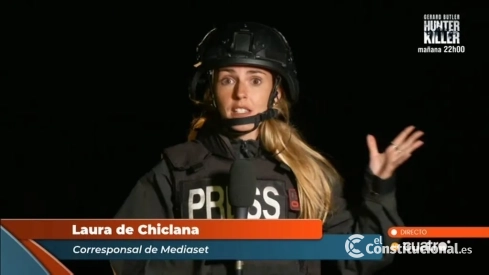
Lara Escudero in Ukraine, Marta Maroto in Lebanon or Laura de Chiclana from Israel represent a new generation of correspondents who are breaking glass ceilings in the coverage of international conflicts.
Journalists who not only inform from the field, but also build credibility before audiences.
That professional authority, however, remains fragile.
This very week, during a live connection from Tel Aviv on Iker Jiménez's program, Laura de Chiclana explained that the Arab community in Israel does not have enough public shelters, a statement that generated controversy when it was publicly questioned from the set itself, discrediting the journalist who was reporting from the scene.
An episode that illustrates to what extent auctoritas in the public space remains a disputed territory.
While international politics continues to be dominated almost exclusively by men, war will continue to be, on too many occasions, a conversation among them.
But something is starting to change: increasingly there are more women disputing the authority to tell it.
And in the world of information —as in politics— auctoritas is not granted. It is conquered.
Add ElConstitucional.es as a preferred Google source for free.
Stay informed about all the latest breaking news with the best information. Against disinformation, for democracy and social rights.