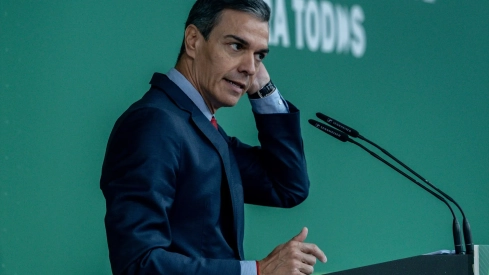
Pedro Sánchez completes this Monday eight years at the head of the Government. The anniversary coincides with one of the most delicate moments of his entire mandate. It was on June 1, 2018, when Congress approved the motion of no confidence against Mariano Rajoy, the first to succeed in the recent democratic history of Spain. The next day, Sánchez promised his position before the King and began a political stage that, eight years later, remains open.
The temporal coincidence arrives amidst a succession of investigations and controversies that affect the political and personal environment of the president. The cases related to José Luis Ábalos, Santos Cerdán, José Luis Rodríguez Zapatero, Leire Díez and, in the personal sphere, with his brother David Sánchez or his wife, Begoña Gómez, have increased the pressure on the Executive and have reactivated the demands of the opposition —and some of its partners— to prematurely end the legislature.
However, despite the political deterioration, nothing seems to move.
The paradox of Spanish politics is that the Government is going through one of its most vulnerable moments while the possibility of an alternative continues to be remote. It is what could be defined as an infinite draw or a Nash equilibrium: nobody is satisfied, but nobody finds an alternative that improves their position nor modifies their strategy.
The Partido Popular has been demanding early elections for months and maintains that the situation is unsustainable. Alberto Núñez Feijóo assures and repeats that he will do “everything” possible to provoke a change of Government. The problem is that the main parliamentary tool to achieve it, the motion of no confidence, requires supports that do not exist today.
The presence of Vox makes that operation practically impossible. None of the parliamentary partners who made Sánchez's investiture possible seems willing to appear backing an initiative led by the PP and supported by the formation of Santiago Abascal.
Other broken relationships
Nor do the relationships between the potential allies of a hypothetical alternative majority help. The link between PP and PNV is going through one of its worst moments. The public exchanges between leaders of both formations reflect to what extent distrust has become a political obstacle in itself. The 'populares' demand from Basque nationalism that it facilitate a change of cycle. The PNV responds by accusing the PP of having tightened its alliance with Vox to the point of making any understanding impossible.
Junts also does not seem willing to assume the internal cost of an operation that would end up facilitating a Government supported by the right and the extreme right. The formation of Carles Puigdemont constantly pressures (or pressured) Sánchez, raises the price of each negotiation and demands new commitments, but one thing is to increase pressure and another to provoke a fall of the Government whose consequences are unpredictable for its own interests.
In the left bloc, something similar happens. ERC, Bildu or even Sumar can harden their discourse and mark distances when they deem it necessary. However, all share the same strategic diagnosis: the alternative would be a PP Executive with Vox or dependent on the ultras. And that perspective acts as a powerful incentive to maintain the current parliamentary majority, however deteriorated it may seem.
Thus, each actor finds reasons to complain about the state of affairs, but almost none finds sufficient reasons to alter it.
La Moncloa tries to convince the PSOE
The tie does not only affect the opposition and parliamentary partners. It also exists within the socialist space itself.
The PSOE is much more than the federal leadership installed in Ferraz. Mayors, councilors, regional deputies, and territorial officials observe with concern the accumulation of judicial and political fronts. Many admit privately that they are unaware of the real scope of some matters and that they lack sufficient information to anticipate how events will evolve.
Not everyone shares the timing strategy set by La Moncloa. Pedro Sánchez has announced that he will appear in Congress within a month to give explanations, although there is still no specific date for that intervention. Among territorial leaders and socialist officials, concern is growing over a reaction they consider too slow given the dimension of the crisis. “A time that can be unbearable,” admit prominent socialist leaders in the Basque Parliament.
In that context, one of La Moncloa's main tasks is to keep the organization cohesive. Ministers and leaders close to the president believe that judicial and political pressure will continue during the coming months and maintain that the response involves reinforcing the idea of “resistance” against those who they believe seek to overthrow the Government through means other than the ballot box.
Eight years after coming to power through a no-confidence motion, Sánchez faces a paradoxical situation. Never had he accumulated so many political problems at the same time. But neither had his adversaries been so far from building a majority capable of replacing him.
That is why the legislature continues to advance. Not because someone is winning the game, but because none of the players seems willing to move the piece that could change it.