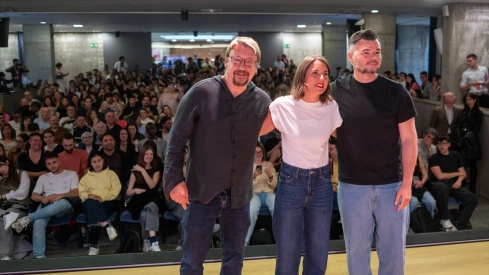
The possibility of two candidacies to the left of the PSOE in the November 29 elections is increasingly plausible. The deadline to register coalitions expires at midnight this Friday and the margin is narrowing.
For now, Frente Amplio is not getting closer to Podemos, nor is Podemos getting closer to Frente Amplio. Between the two possible paths, the purples lean towards collaborating with Gabriel Rufián, who in recent months has proven to be a powerful mobilizer against the right-wing parties and, therefore, the most attractive electoral option.
For months, the pro-independence leader advocated for a strong left and even threatened to lead that movement: the left needs "science, method and order," he argued at the beginning of the year in a political event at the Galileo Galilei hall in Madrid.
His final decision to remain under the ERC acronym has disappointed broad sectors of the left. From some areas of Sumar, they even admit that they see the horizon of an agreement "more complicated" after the Catalan leader's moves with Podemos.
An electoral "tandem": joint events by Rufián and Montero
The idea is simple: Podemos campaigns in Catalonia in favor of ERC and Rufián supports Irene Montero's leadership in the rest of the State. They would do so through joint campaign events that the republican leadership would have accepted after negotiating with the Podemos leadership in Madrid.
The details of the agreement have not been disclosed —the hermeticism between the parties is total—, but ERC could even include independent Podemos candidates on its lists. This without forgetting that the Regulations of the Congress of Deputies establish very clear limitations on how parliamentary groups can be organized when parties share candidacies. That is, if Podemos and ERC share lists —or integrate candidates into the same electoral list—, parliamentary regulations prohibit the constitution of separate groups.
While the possibility of the leaders of the purple party visiting Catalonia to support Rufián and ask for votes in favor of independence approaches, the path for Ada Colau to lead Frente Amplio closes.
The former mayor of Barcelona is one of the leaders of the Comuns, a space in which Podemos in Catalonia was once integrated and which ended up fracturing after the state-level rupture between Podemos and Sumar.
If ERC competes for the electoral space with the Comuns and Podemos supports independence, the Colau path loses traction.
The turns of Más Madrid, with no place for Podemos
After Rufián's announcement that he will continue to lead ERC, Más Madrid "celebrates" the decision and once again surprises by proposing that the Frente Amplio list be headed by Emilio Delgado, deputy spokesperson for the party in the Madrid Assembly, with the Minister of Health, Mónica García, as number two.
García, who months ago announced that she would be Isabel Díaz Ayuso's electoral rival in the next regional elections, thus returns to the national forefront. It is a move that even within her own party they do not fully understand and that reopens questions about the regional seat.
The Madrid party opens up for the first time to integrate Podemos, without going into details. It explains that it is a proposal "of integration" of all Frente Amplio actors to "unblock" the current situation.
After rejecting the open primaries proposed by the purples, and just a few days before the deadline for submitting candidacies, Más Madrid does not clarify how to fit in Podemos, which is already charting its own path and rules out incorporating Colau into the Madrid list and proposes as alternatives the deputy Tesh Sidi, who was number three for Sumar in the 2023 general elections, or the Madrid City Council councilor Eduardo Fernández Rubiño.
Analysis | The division of the lefts to no one's surprise
Rufián inflated an illusion that has come to nothing. He would have done well to be more cautious: not all movements are false steps.
Más Madrid, as the leading space of Sumar, knew for months that this situation could occur and has ended up trapped in a predictable scenario, burdened by internal personalisms.
Podemos does not forget 2023, when Sumar dealt them the blow. It no longer seeks to grow alongside other formations, but to protect its small core and the survival of the brand.
Therein lies the paradox. The experience of other countries suggests that the Frente Amplio brand has only survived when the parties that composed it subordinated their acronyms to the whole. Today, in Spain, ERC maintains its leaderships, Podemos shields its brand, and Más Madrid drags its personalisms: no one seems willing to take that step.