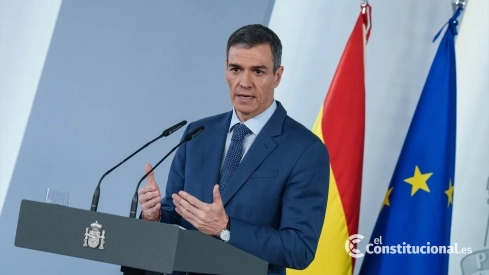
The reality, at this hour, is that nobody knows anything. The pools can be fulfilled… or blow up. The decision is in the hands of the President of the Government, Pedro Sánchez, and, for the moment, not even in his closest circle do they seem to know what the outcome will be.
The head of the Executive also faces a high public exposure agenda in Congress during today and tomorrow, with several appearances and planned events. However, for a matter of institutionality and respect for parliamentary times, at Moncloa they do not expect him to leave clues about the reshuffle in these interventions.
The move by Juanma Moreno Bonilla, by anticipating the Andalusian electoral calendar, has caused an expansive effect that has quickly crossed autonomous borders. The wave has reached the Palacio de la Moncloa, where Sánchez is finalizing a specific government reshuffle to cover the departure of the still vice-president and Minister of Finance, María Jesús Montero, who will be a candidate in the elections scheduled for May 17.
Sources from the Executive confirm that the president is satisfied with the current composition of the Council of Ministers. Therefore, the intervention will be surgical and limited, in line with what he himself already anticipated months ago: continuity with minimal adjustments.
At Moncloa they prefer to let the next hours pass to save several relevant milestones on the political agenda. Among them, the appearance at the president's own request —in which a speech of marked ideological content is expected— to set Spain's position regarding the war in the Middle East and report on the last meeting of the European Council. Also on the calendar is Thursday's plenary session, with the debate and the foreseeable validation of the decree-law on economic measures derived from the conflict.
From there, the window opens. After Thursday's plenary session —and before receiving the lehendakari, Imanol Pradales, on Friday morning at Moncloa— the appearance in which Sánchez announces the changes could take place. If not then, the scenario shifts to Monday. In any case, before the next Council of Ministers, already without Montero at the table.
Pools that take body
The prerogative to open crises —large or small— is exclusive to the president. This time, at least for now, no one has certainties. Not even those who usually anticipate the movement.
Yes there are, however, some lines that are starting to be drawn. One of them suggests that the vice presidency could remain in the hands of a woman, while the Treasury portfolio would fall to a different profile.
Among the names that are sounding strongest is that of Carlos Cuerpo, current Minister of Economy, who has not publicly shied away from his inclusion in the pools: “The fact that I am included in these types of scenarios means that, in economic policy, a good job is being done,” he let slip during the press conference after Tuesday's Council of Ministers.
It would not be an anomaly in the European context. In other governments in the region, the unification of the Economy and Finance portfolios is common, a possibility that was also left open by the Minister of Territorial Policy, Ángel Víctor Torres, in an interview last night with Xabier Fortes: “There can be a ministry that integrates both competencies”.
Another name gaining weight is that of Jesús Gascón Catalán, current number two of Montero, who appears in the pools as a technical profile with options to assume ministerial responsibilities.
Félix Bolaños, the axis of the engine room
The role of Félix Bolaños will only be strengthened. Considered the “super minister” of the Executive, he is in charge of the engine room: he coordinates ministries, manages crises and acts as the main political firewall.
He/She has piloted some of the most complex negotiations of the legislature, both with partners and with the opposition: from the attempts at renewal of the General Council of the Judiciary to the processing of the amnesty law or the investiture agreements with ERC and Junts.
With Montero's departure, his internal weight will predictably increase. It remains to be seen if that reinforcement will translate into new formal competencies. Politically, in any case, he will remain a key piece: the most valuable bishop on Sánchez's board in the decisive stretch of the legislature.