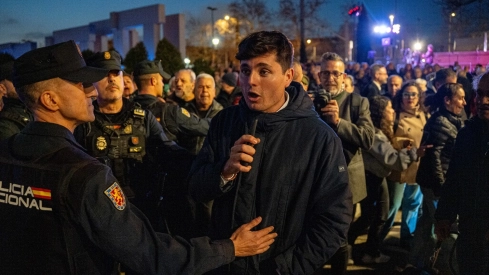
For some time now, the Congress of Deputies has ceased to be solely a space of democratic control to also become a scenario where noise competes with information. Activists converted into supposed reporters —like Vito Quiles or Bertrand Ndongo— have made confrontation, provocation, and the hoax their main tool for visibility.
It is not an anecdotal phenomenon. It is a business model. Thousands of followers, viral videos and a clear strategy: to strain the limits of the system to convert every incident into content. The problem is not only one of style; it is one of nature. Because not everyone who holds a microphone practices journalism, just as not everyone who wears a uniform represents the law.
Journalism is a craft. It demands method, contrast, responsibility, and limits. Reducing it to a channel of permanent confrontation not only degrades the profession: it directly erodes the functioning of institutions.
Add and continue: more than a dozen files in processing
The volume of open files reflects that the situation has ceased to be tolerable even for the flexible standards with which the Chamber has traditionally operated. According to sources from the Board, there are “more than a dozen complaints in different stages of processing”, with special concentration on repeat offender profiles.
In the case of Vito Quiles, there are at least half a dozen files. If those linked to Bertrand Ndongo are added, the total figure largely exceeds ten. Each complaint is processed independently, but their accumulation allows raising the level of sanctions. In at least one of those files, Quiles filed an appeal under the provisions of the regulations, although he did so out of time; despite this, the lawyer admitted it, a decision that, according to parliamentary sources, would not conform to the established procedure.
The last formal complaint has been presented this very morning by the parliamentary group Sumar after Ndongo called deputy Aina Vidal “idiot” in the press room and, subsequently, tried to prevent her from getting into a taxi in the outer area of the Congress.
Tomorrow itself, the Consultative Council —integrated by political representatives and information professionals— will meet for the fifth time, by instruction of the president of the Congress, Francina Armengol, after the last complaint registered against Vito Quiles, in this case promoted by Podemos at the end of April. A meeting that will serve to open the way for a new file.
The registered complaints are already, in many cases, in the hands of the Secretaría General, where a lawyer analyzes the facts and prepares a report with sanction proposals. The final decision corresponds to the Board, which can order its immediate application as soon as it receives said report.
In the Presidency of the Congress they assume that “the reiteration of conduct can justify more severe measures”. Among them, the withdrawal of accreditation as a prior step to the effective expulsion from the parliamentary information circuit, something they consider possible “at least during what remains of the legislature”. The idea is that, once expelled, they cannot return for a long period of time, explain the same sources.
A new regulation facing persistent impunity
The reform of the regulation approved in September 2025 was born precisely to avoid this type of situations. For the first time, a clear sanctioning framework was established for people accredited as journalists who obstruct parliamentary activity or alter the ordinary functioning of the media.
The text includes up to 17 types of infractions classified by severity. Among the most severe are included disrespect, intimidating behaviors, confrontations within the premises, or covert recording in reserved spaces. Assumptions that, far from being theoretical, have already occurred. Some of the episodes have happened in the last hours.
The intention of the regulation was clear: to limit impunity. Reality, however, has gone behind the norm.
Because while the files accumulate in the offices, in the street the dynamic hardly changes. Week after week, some of these profiles continue overstepping the security limits outside the Congress, with a permissiveness on the part of the police that contrasts with the rigidity that is applied to the rest of the professionals.
The result is a difficult-to-sustain anomaly: a regulation designed to order that has not yet managed to impose itself on those who live, precisely, by defying it.
And that is where the Congress Bureau stakes something more than the resolution of some files. It stakes drawing a clear line between information and agitation. Between journalism and spectacle.
Because if that border disappears, what is degraded is not just a profession. It is the democratic space itself that it intends.
Add ElConstitucional.es as a preferred Google source for free.
Stay informed about all the latest breaking news with the best information. Against disinformation, for democracy and social rights.