There is nothing new in the idea that the far-right spreads hate. It does so recurrently, responding to a scheme on which it builds its political ideology. But after what happened in Ceuta this week —a crisis for which the lack of foresight on the part of the Spanish Government is evident and which, had it been anticipated, could have been avoided—, much of the public debate has ended up marked by the movements of far-right parties and groups.
For years we have been witnessing a rise of ultra-currents that gain strength and prominence by capitalizing on crises of various kinds. They absorb and use the suffering of those who endure situations such as the massive assault on Ceuta to expand their political capital. The worst face of this crisis, however, are the 67 people who died —a figure that could increase—. These are the most dramatic consequences of a situation that, for some, ends up becoming an opportunity to fuel hate speech.
Given this scenario, various authors and experts, such as historian Carles Viñas (Barcelona, 1972), have reiterated in recent months the need not to abandon any space to fight against those who whitewash these phenomena.
This is the framework in which what happened in the last few hours is explained. With the flag of hate always ready and when the situation on the ground was practically resolved —almost all the people had already started the reverse journey to return to Morocco in less than 48 hours, according to the Ministry of Foreign Affairs—, the far-right showed up with various calls in the center of the Autonomous City. What they perhaps did not count on was that everything would be resolved ahead of time.
But with what objective are they in Ceuta?
To save the homeland.
Ceutians rebel and stand up to the ultras
In the same place —Plaza de los Reyes in Ceuta— and at different times —Núcleo Nacional at 6:00 PM and Se Acabó la Fiesta at 8:00 PM—, some factions of these two far-right and neo-Nazi groups met on Saturday afternoon in the center of the Autonomous City.
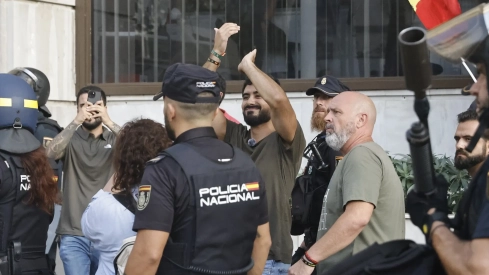
Without the capacity to resolve even one of the multiple derivatives drawn by the complex situation that Ceuta already experienced in 2021 and which depends, to a large extent, on Morocco's predisposition and new prevention plans by the Spanish Government, figures such as Alvise Pérez, leader of Se Acabó la Fiesta, the agitator Vito Quiles —who thus had an excuse to continue his tour initiated during the course— or neo-Nazi members of Núcleo Nacional made an appearance in the city center, where they were heckled by the citizens who reside there.
The National Police had to intervene in the area due to the arrival of countless neighbors who heckled the ultras with shouts of "get out of here!" or "we are also Spanish!". Other citizens gathered in the area reproached the presence of the SALF leader and Quiles in the city in the midst of a migratory crisis. "We are suffering and you are taking advantage of the situation," they expressed.
In addition, about 20 members of Núcleo Nacional —some with their faces covered, like thieves robbing a jewelry store— had to be escorted by the National Police to the port of Ceuta, after protests by Ceuta citizens of Moroccan origin.
With a heated atmosphere and with the people of Ceuta, who are the ones who have suffered the situation, relegated to the background by the ultras, the parade of the saviors of the homeland has not ended. This Sunday, the city will be visited by the leader of Vox, Santiago Abascal, who is tightening the screws on the PP in the communities where they govern jointly.
Simplistic explanations, hate speech and a shift towards the ultra
The main opposition groups, Partido Popular and Vox, who aspire to govern the country after the next elections, know that relations with Morocco are a fundamental piece to contain the migratory movement at the Tarajal border.
The PP, which has already governed Spain, has had to maintain relations with Rabat in the past and will presumably not break them —no matter how much it now raises criticism and insists that the Government knew what was going to happen— if it returns to Moncloa.
What is already happening is a domino effect that Santiago Abascal's party usually applies in these types of situations: nationalizing a message from the scene of the events and transferring it to all the territories where it has responsibilities.
Thus, Vox has already ordered the suspension, in the four regional governments where it has power, of aid to NGOs "that collaborate or finance the migratory invasion of Ceuta," with the aim of "preventing a single public euro from ending up financing those who protect" that invasion.
A term, that of invasion, which, unlike what happened in 2021, has also been used this weekend by the leader of the Popular Party, Alberto Núñez Feijóo.
Meanwhile, in the last major crisis, five years ago, Feijóo stated: "it is the moment for unity. Warlike language should not be used (...) we must continue talking with Morocco, it is an ally, neighbor, and client of Spain."
This time he has preferred to use terms such as "scorched Spain" or "invaded." A hardening of the discourse that is explained by two reasons: the first, by the permanent attempt, in his opposition work, to expel Sánchez from Moncloa; and the second, by the direct competition from Vox, which not only steals votes from the PP, but also benefits from this type of situation.
The consequence is a progressive displacement of the political framework. When the discourse of the far-right is incorporated into the debate of traditional parties, even if with nuances or different electoral objectives, the playing field changes. And in that field, complex explanations lose space in favor of simple, emotional messages built on fear.
The ghost of immigration sweeps across Europe
The reaction of some European countries, among others, neighboring France and Italy, shows that the ghost and fear of immigration are sweeping a large part of the community club.
Spain, one of the few social democratic powers, has been left alone in the defense of some values, with the Government recently defending, for example, the regularization of migrant people. A process that closed its deadlines last January, but which PP and Vox have used to point to a "pull effect," to which other EU powers have joined. Including social democratic Denmark, which led, along with Italian far-right leader Giorgia Meloni, the letter in which they called for a hard line against mass arrivals.
However, Pedro Sánchez seems willing to stand up to the "lack of solidarity" and "selfishness," they say in Moncloa, that these countries have shown and that the president himself criticized in a letter sent to Brussels.
It is not the first time that Sánchez has found himself alone in the face of international conflicts, such as the genocide in Gaza committed by Israel or the war waged against Iran by the US. However, this time, the battle, in addition to being external, is above all internal, with a PP increasingly to the right and an Executive that seeks to continue holding the containment dike.
Because Ceuta is not only the scene of a migratory crisis nor the board of a political dispute. It is also the place where dozens of people have lost their lives and where an entire city has had to face a situation of enormous gravity. Turning that suffering into electoral fuel may be profitable in the short term, but it has an evident democratic cost: it displaces the debate about solutions and replaces it with a competition to see who formulates the most forceful message, who raises their voice the most, and who manages to present the other as a threat.
The far-right knows this terrain well. Its strategy consists, precisely, in turning fear into identity and crisis into opportunity. The risk appears when that framework ceases to be marginal and begins to condition the discourse of politics as a whole.
And, while some compete for the narrative of “saving the homeland,” the reality remains much more uncomfortable: there are 67 people dead, a figure that could still be higher, and a crisis that demands political responses, much diplomacy and community collaboration, not slogans.
Add ElConstitucional.es as a preferred Google source for free.
Stay informed about all the latest breaking news with the best information. Against disinformation, for democracy and social rights.