While VOX's far-right consolidates electoral space with a discourse based on the confrontation between an “us” —presented as a victim— and a “them” —where the migrant is singled out as guilty—, Pedro Sánchez's Government will give the green light this Tuesday to the regularization of nearly 500,000 people.
The measure has its origin in a Popular Legislative Initiative (PLI) backed by more than 700,000 signatures and will be approved by royal decree, thus avoiding its passage through an always uncertain parliamentary majority. The technical teams of the Executive are finalizing the final adjustments to the text during the weekend.
The Council of State —the supreme advisory body of the Government whose main functions include ruling on matters submitted by the Executive— has endorsed the approach, although it introduces nuances that the Government will incorporate to improve its application and legal certainty.
From criminal record to international protection
Beyond extraordinary regularization —a mechanism previously used by governments of both the PP and the PSOE—, current legislation also contemplates International Protection for those who prove risk in their country of origin.
At this point, the Council of State clarifies that both paths cannot be accessed simultaneously. In case of concurrence, the asylum permit will remain valid until the residence and work authorization is favorably resolved.
One of the key focuses is on the accreditation of criminal records. The initial draft allowed replacing the official certification with a responsible declaration in case of difficulty in obtaining it. However, the advisory body raises the bar: it demands rigorous accreditation and warns that, “in the absence of this documentation, the procedure will be suspended”.
It also introduces precision on the concept of vulnerability, which must be clearly defined. In principle, it is limited to people who arrived in Spain before January 1, 2026 and who can prove at least five months in an irregular administrative situation.
Government versus PP and VOX: political clash and battle for the migration narrative
Regularization is part of recent political tradition in Spain. José María Aznar promoted processes that affected nearly 500,000 people, and José Luis Rodríguez Zapatero extended that figure to 700,000. Neither did a system collapse occur then, nor did a terrorism-related threat emerge from those decisions.
However, the current political context draws a clearly opposing bloc. The Popular Party, led by Alberto Núñez Feijóo, has raised the tone in European forums, warning that the measure could “export a migratory problem” to the entire European Union, in line with the discourse that VOX has been sustaining.
In parallel, the Madrid president, Isabel Díaz Ayuso, has announced her intention to appeal the process, denouncing an “uncontrolled” regularization and warning of its impact on public services.
The positioning presents, however, contradictions. While the Community of Madrid continues to outsource healthcare services —with relevant contracts awarded to private groups such as Quirónsalud—, a supposed risk of collapse is warned of. At the same time, a favorable reception policy is maintained towards certain groups, such as Venezuelan citizens, in contrast to the general rejection of regularization.
The convergence between PP and VOX on immigration matters has been made explicit in recent initiatives. Last March, the joint National Security commission approved with their votes a report to study the possible relationship between migration and terrorism, consolidating a shared discursive framework.
A week marked by migration
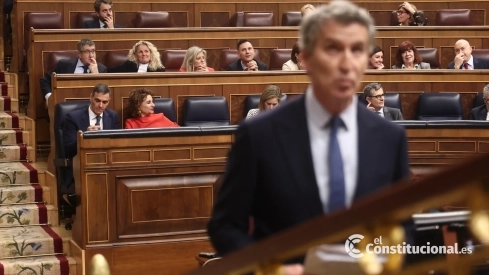
The absence of Pedro Sánchez, on an official trip to China, will reduce the immediate voltage of the control session in Congress. However, the migratory debate consolidates as a central axis of the political agenda this coming week.
The Government seeks to mark profile and establish position in a terrain where not only management is debated anymore, but also narrative. And where every movement begins to be measured, without dissimulation, in electoral key.