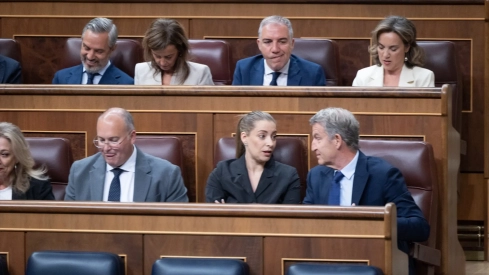
The PP, which governs the City Council of the capital and the Community of Madrid, primarily responsible for legislating on housing in their area, has chosen to remain silent about the eviction of Maricarmen, an 87-year-old woman. Microphones pursued yesterday the regional president of Madrid, Isabel Díaz Ayuso, the leader of the opposition, Alberto Núñez Feijóo, and even former president José María Aznar. None had anything to say.
Just hours before the eviction, Ayuso participated in an international meeting on real estate investment. “We defend property at all costs from a fiscal point of view and from all our policies, because property is sacred,” she declared. The phrase well summarizes the model defended by the popular party: the priority of speculation over the right to housing.
Added to this is the recent controversy over the regional government's purchase of a penthouse valued at 6.3 million euros, which they have not yet explained.
Likewise, in January, Feijóo's PP voted along with Vox, Junts, and PNV against the extension of the exceptional measure promoted during the pandemic that would have prevented Maricarmen's expulsion from her home.
Indignation over the eviction
The eviction of Maricarmen, 87, in Madrid has unleashed a wave of indignation that has swept through the streets of numerous cities in recent hours.
In Moncloa there is concern about the impact of an eviction that was narrated live and is already summarized as one of the biggest failures of the system. Neither the central government, nor the regional government, nor the City Council, nor justice, nor the thousands of people who accompanied Maricarmen managed to prevent her right to housing from being sacrificed to the economic interests of a real estate company. This is Urbagestión, linked to Ricardo Alonso Fernández and Fernando Alonso Fuentes, which has avoided any negotiation to monetize the acquired apartment as soon as possible.
The Executive's concern was noted on Wednesday afternoon, when it was learned that Pedro Sánchez would mention the case from New York. “Today's eviction of Maricarmen is a social tragedy that we cannot accept as a country, nor of course from the point of view of public institutions,” he stated at a press conference. Sánchez took advantage of the platform to announce that “urgently” he would send a new royal decree on housing to the Congress of Deputies.
Housing drafts the text
Sumar, the minority partner in the Government, has been demanding for weeks that the PSOE bring the decree to the Council of Ministers. It was scheduled for July, but the lack of parliamentary majorities caused its postponement. Now, several socialist ministers admit that the Government "must show more courage" in the face of a problem that affects millions of citizens.
According to sources from Moncloa, the Minister of Housing, Isabel Rodríguez, is already drafting a text that is being negotiated with Sumar and that must incorporate the proposals, some contradictory, of the parliamentary partners. It aims to regulate current issues, such as room rentals, which the Housing Law did not contemplate, and prohibit evictions without housing alternatives.
The crisis opened in Ceuta has displaced other issues, such as housing or the budget project. Now the Government seeks to lead the political response to a social shock without having guaranteed the majority that would validate a decree that could protect millions of families.
Sources from the Ministry of Housing confirm, without going into details, that they are already in contact with the spokespersons of the groups. The difficulty lies in reconciling the demands of ERC, EH Bildu, or Podemos with those of PNV and Junts, who are more concerned with protecting small property owners.
Add ElConstitucional.es as a preferred Google source for free.
Stay informed about all the latest breaking news with the best information. Against disinformation, for democracy and social rights.