The Spanish Data Protection Agency (AEPD) has opened this Wednesday an ex officio investigation into the list prepared by the Ministry of Interior that classified 280 journalists and commentators according to their supposed ideology, their political opinions, and their position towards the Government.
The body will analyze "the nature, scope, use, and legal basis" of the processing of these personal data, as announced in an informative note. The Agency emphasizes that the opening of the file leaves open the conclusion about the existence of possible infringements.
The intervention of Data Protection raises the dimension of a case revealed this Tuesday exclusively by 'El Confidencial'. The document, titled 'Commentators. Radio and Television', was prepared by the Interior Communication Office in February 2024 and contains photographs, professional careers, collaborating media, and political assessments.
Among its pages appear expressions such as "aligned with the PSOE", "supports the Government", "aligned with right-wing positions", "recognized anti-Sánchez", "critical of the amnesty" or "lately she is more combative". Some files include opinions on Pedro Sánchez, the pro-independence parties or the amnesty law, matters far removed from the ordinary competencies of the department headed by Fernando Grande-Marlaska.
The AEPD reminds that any processing of personal information must have a specific purpose and a legal basis. Political opinions and ideology also belong to the categories specially protected by the General Data Protection Regulation (GDPR), whose article 9 establishes a general prohibition and limits the circumstances that allow the use of such information.
Marlaska denies a "blacklist" and Sánchez considers it "very inappropriate"
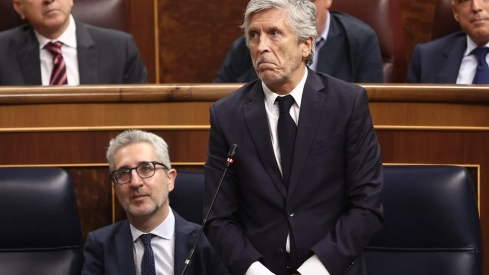
The Minister of Interior defended this Wednesday in Congress that the dossier was an internal document aimed at improving the department's communication. "No blacklist goes with us", he responded to the general secretary of the PP, Miguel Tellado, during the control session.
Marlaska also maintained that in the report "people are not defined by ideology". This statement clashes with the labels reproduced in the document and with the investigation opened by the AEPD itself, focused precisely on the processing of data related to political trends and opinions.
Interior had already admitted on Tuesday the authenticity of the list and explained that it had a "consultative" purpose. The Ministry assures that none of the profiles conditioned access to information, institutional treatment, or the response offered to journalists. It has also apologized to those who may have felt offended by the content and some of the assessments included.
The President of the Government, Pedro Sánchez, has distanced himself somewhat during an interview on 'Mañaneros 360' on Televisión Española. He has assured that he was unaware of the existence of the list and has described it as "a very inappropriate document" and "unfortunate". Sánchez has guaranteed the Executive's respect for the autonomy of the media, although he has also reproached the right for its threats against journalists and the public financing of far-right agitators.
The rejection reaches PSOE, Sumar, ERC, and press associations
The Federation of Associations of Journalists of Spain (FAPE) and the Press Association of Madrid (APM) have expressed their "most energetic condemnation" and consider that the creation of ideological profiles by a public administration is "incompatible with the rule of law".
Professional organizations warn that Interior has the capacity to influence access to sources, accreditations, and institutional treatment. The existence of a classification between "friendly" and "problematic" journalists can generate, according to both associations, a feeling of surveillance capable of conditioning the exercise of critical journalism.
Censures have also come from the groups that support the Executive. The socialist spokesperson in Congress, Patxi López, has assured that he "absolutely" dislikes lists that classify people by their thoughts or ideology and has demanded explanations from the Ministry. The Compromís deputy integrated into Sumar, Alberto Ibáñez, has described the document as an "attack on press freedom", while Gabriel Rufián, of ERC, has called it "shabby" and "misappropriating shabbiness" if public resources were used to produce it.
The PP has called for Marlaska's resignation and Miguel Tellado has compared the practice to a "banana dictatorship". The far-right Vox has also demanded his departure, although it has taken advantage of the controversy to mix it with its accusations against the Government for the migratory crisis in Ceuta.
The investigation must now determine the purpose of the dossier, who accessed its files, for how long they were kept, and what legal coverage the Interior Ministry used. The FAPE has demanded the cessation of any profiling practice, guarantees that no journalist suffered different treatment, and the clearing of responsibilities within the Communication Office.
Add ElConstitucional.es as a preferred Google source for free.
Stay informed about all the latest breaking news with the best information. Against disinformation, for democracy and social rights.
