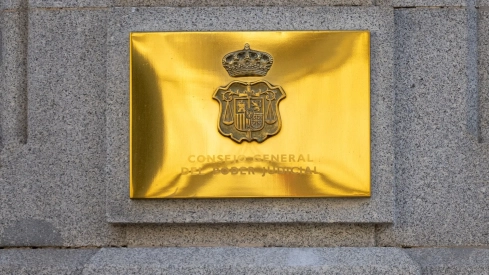
The Center for Sociological Research (CIS) has put numbers to a feeling that has been traversing political conversation for months. 76.9% of Spaniards believe that Justice does not always act impartially when investigating matters affecting political parties. The data comes amidst a succession of judicial cases, accusations of 'lawfare', clashes between the Government and judges, and partisan offensives built around the courts.
The fourth survey on democratic quality, published this Monday, reflects a very deep distrust towards the functioning of the system. 88.8% believe that Justice does not treat a politician the same as an ordinary person. 78.4% believe that it also does not treat rich and poor equally. The picture is clear: citizens continue to defend democracy, but look with suspicion at many of its institutions.
The study was conducted between June 9 and 12, with 4,027 interviews, at a time especially loaded with judicial news and corruption cases. This context matters. The headlines of recent weeks have been marked by investigations affecting the Government, the PSOE, Pedro Sánchez's inner circle, the Popular Party and media cases such as that of Begoña Gómez, with the controversial judge Juan Carlos Peinado at the center of the controversy.
Democrats, but very dissatisfied
The survey maintains a solid data for the system: 80.8% of citizens believe that democracy is preferable to any other form of government. The Transition also retains broad support, with 72.7% seeing it as a source of pride.
The problem appears when asked about the actual functioning of that democracy. Only 20.5% declare themselves very or quite satisfied. 56.9% say they are little or not at all satisfied. The gap between support for the system and weariness with its functioning explains a good part of the current climate.
The discomfort is not concentrated only in the courts. 87.5% believe that the mechanisms to combat corruption are insufficient. 75.3% think that parties care little about what people think. And 75% share the idea that, whoever is in power, politicians seek their own interests.
Even so, three out of four citizens still consider that without parties there can be no democracy. The rejection does not seem to be against representative democracy as an idea, but against the way in which its main actors are managing it.
Justice, 'lawfare' and the Peinado climate
The CIS judicial data arrives on the same day that another 40dB poll for 'El País' and 'Cadena SER' indicates that 65.4% of citizens believe that 'lawfare' exists in Spain. It also shows that only 32% see judicial resolutions on political matters as impartial.
This framework helps to understand why every judicial decision with political impact turns into fuel. The case of Begoña Gómez, Peinado's precautionary measures, the file opened by the CGPJ against the magistrate, and the reactions of the Government and the PP have once again placed trust in Justice at the center of public debate.
The electoral reading also weighs heavily. The right insists on presenting every judicial case as evidence against Sánchez. The Government responds by denouncing a political use of the courts. In between, the CIS survey shows a citizenry that no longer fully buys into the idea of a Justice detached from power, money, or partisan interests.
The media also do not fare well
The CIS also hits the media ecosystem. 81.5% of respondents believe that the media echoes hoaxes and lies. 88.9% believe that they favor some political options or economic interests more than others. Furthermore, 57.7% consider that journalists now have less freedom and independence than ten years ago.
This data fits with an increasingly judicialized policy that is more dependent on the immediate headline. Every order, every leak, every popular accusation, and every investigation with a proper name enters a chain of noise that ends up harming all actors at once: judges, parties, media, and citizens.
On the institutional trust scale, only the Armed Forces approve, with an average score of 6.96. The courts remain at 4.74, the Constitutional Court at 4.34, the Government at 3.79, and political parties fall to 2.92. This is the lowest score on the entire list.
The survey also leaves a very specific demand. 89.8% believe new forms of citizen participation in public affairs are necessary. There are also broad majorities that call for ethical codes for party officials, more youth participation, and more internal democracy in political organizations.
The CIS does not ask about Peinado, nor about Begoña Gómez, nor about the latest clash between Moncloa and the PP. But the data lands precisely in that climate. A democracy backed by the majority, a Justice under suspicion, suspended parties, and a citizenry that demands more control against corruption.
