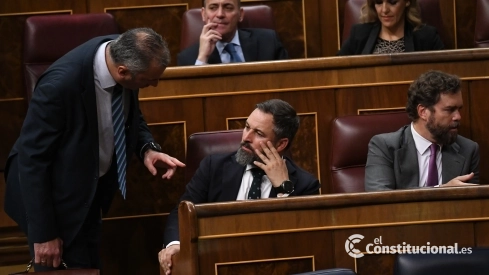
Several former leaders and critical voices of Vox, among them Iván Espinosa de los Monteros and Javier Ortega Smith, have promoted a manifesto in which they demand the holding of an extraordinary congress of the party. The objective, according to the text disseminated on an unofficial Vox website at midnight on Wednesday, March 18, 2026, is to open an in-depth debate on the political direction and internal functioning of the formation.
The signatories demand a congress open to all members and ask that it be held with “sufficient deadlines and clear rules,” in a way that allows for a “complete review of the party's internal architecture.” They also advocate for an “open debate on leadership, organization, political orientation, and government strategy,” insisting that their initiative does not seek “to impose an alternative candidacy” nor to act against Vox. In one of the manifesto's most prominent phrases, they maintain that “political loyalty is to ideas, not to people.”
In addition, critics are asking for “a serious political explanation” about the changes in orientation registered in recent years and demand to publicly contrast if these changes are compatible with the foundational ideas of the project. In their opinion, the congress should serve as a space for “serene and demanding contrast” to discuss both the political and ideological ideas and the organizational model of the party.
On the strategic level, the promoters admit that Vox has grown at some moments in voting intention, but they consider that it has not managed to “dispute the hegemony in our own political space”. Therefore, they warn that ending up converted into a “kingmaker party” of the PP would mean, in their opinion, a “strategic failure”.
The manifesto also attacks the internal structure of the party. Critics denounce “the extreme concentration of power and the elimination of internal controls” and express their concern about the alleged existence of “a parallel network of opaque entities”, unknown to most members and, they say, linked to economic interests and exchanges that demand transparency.
Along with the manifesto, the promoters have disseminated a form to gather support among members and former members. The key fact is statutory: extraordinary meetings must be convened by the National Executive Committee or at the written request of at least 20% of the full members, who must also indicate in their request the proposed agenda.
Among the promoters are, in addition to Espinosa de los Monteros and Ortega Smith, the Madrid councilman and first president of the party, Ignacio Ansaldo, and the former first vice president Víctor González Coello de Portugal, among others. The initiative comes shortly after Vox announced the definitive expulsion of Ortega Smith for a “very serious infraction,” after frustrating his replacement as spokesperson for the Madrid City Council; that episode resulted in a disciplinary file for disobedience and his suspension of membership.
In that context, the manifesto also criticizes the "removal of historical leaders and profiles" committed to the project without "sufficient explanations," and warns that the party cannot do without that experience or reduce its internal plurality.
The news also includes recent statements from the two most visible names of this internal offensive. The previous Monday, Espinosa de los Monteros stated on the social network X that the current leadership of Vox “shows capacity to retain, but not to expand”. For his part, Ortega Smith assured after his expulsion that it is “four” who truly rule the party, that they do it “for the money” and that he perceives “personal vanity” in Santiago Abascal.
Add ElConstitucional.es as a preferred Google source for free.
Stay informed about all the latest breaking news with the best information. Against disinformation, for democracy and social rights.
