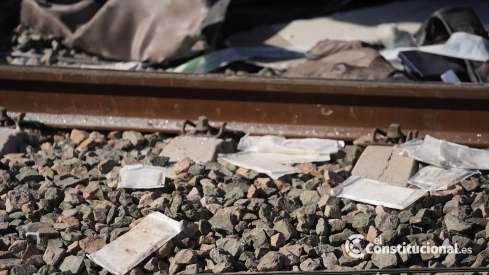
Main hypothesis of lane fracture
The first preliminary report from the Railway Accident Investigation Commission (CIAF) on the serious train accident in Adamuz (Córdoba) suggests that the rail fractured before the Iryo train involved passed over it, and that this fracture could have triggered the high-speed train's derailment, according to sources specialized in the investigation.
Technicians have found notches on the right wheels of several train cars, especially cars two, three, four, and five, consistent with an impact against an already broken rail. This pattern of marks suggests that the track's continuity was interrupted before the accident, which would have created a step on the rail surface that was impacted at high speed.
Technical Analysis and Fieldwork
The teams are investigating a fracture located at the weld between two sections of the track, a critical point where metal samples were collected for subsequent laboratory analysis. These samples, along with undamaged track segments and data from the recorders of both trains involved (Iryo and Renfe's Alvia), will be sent to specialized facilities in Madrid for more detailed studies of cause and origin.
Researchers have observed that similar notches are also found on the wheels of other trains that passed through the same area hours before the accident, reinforcing the idea that the fracture was not a direct consequence of the crash, but may have been present beforehand. Specifically, three trains that traveled on the same track before the accident showed similar marks on some of their right-side wheels, according to subsequent inspections:
-
Renfe train 130 at 19:09.
-
Iryo 109-003 at 19:01.
-
Iryo 109-011 at 17:21.
This reinforces the hypothesis that the track fracture occurred before the passage of the crashed train, opening new lines of investigation into track maintenance and inspection.
Why it's relevant
The hypothesis of a previous rail break would explain why Iryo's car six was the first to derail, as the continuity of the rail broke at high speed —close to 200 km/h— the wheel found no stable surface and forced a track overturn, causing the train to leave the line and subsequently collide with the other convoy.
Although these preliminary conclusions offer a concrete line of work, researchers warn that the cause of the accident cannot yet be definitively attributed to that fracture without the metallographic and structural analyses that will be carried out in the laboratory in the coming weeks. The trains' black boxes will also be examined to accurately reconstruct the moments before the disaster.
For the moment, no cause is ruled out, and the investigation remains open, including the examination of black boxes and other expert data to determine how and why the track broke.