Today I want to talk about something that should be a factor, an element of unity and not a factor of division. I am referring to the Adamuz tragedy. Do you know about it? A railway accident that has cost the lives of 43 people, left families devastated, and has an entire country in mourning. The tragedy continues, continues, continues amidst a full investigation, and rescue teams continue to work under very harsh conditions in Córdoba. It is not the time, therefore, for spectacles or political squabbles.
From the outset, there were gestures of institutional unity. The Prime Minister visited Adamuz, declared official mourning, and insisted on coordinating with local and regional administrations. However, and here lies the first tension, that initially sustained political truce seems to be cracking, especially within the Popular Party. Significant sectors of this party, led by parliamentary spokesperson Esther Muñoz and secretary-general Miguel Tellado, are pushing to break the truce and directly blame Pedro Sánchez's government for the tragedy, alleging negligence in the maintenance of the railway system and controversial technical decisions.
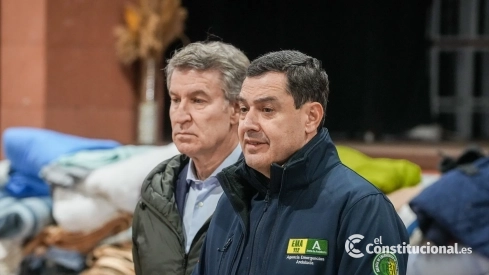
On the other hand, the circle around **Juanma Moreno**, president of the Junta de Andalucía, asks for time and patience because he needs to continue maintaining the climate of unity that has been prominent until now. It is no coincidence that a PP baroness, the president of the community, Isabel Díaz Ayuso, accustomed to being the first to attack Sánchez's government for much less than this, has maintained a scrupulous silence until today, which we know she will eventually break. And they know this in the Popular Party too. Watch out, be careful.
It is legitimate to demand explanations and accountability when there is evidence, when the facts are known, and when the technical investigation so demonstrates. But what is happening now is that these same discourses are emerging before there are official conclusions. And that is the line I want to point out, which is even more serious. There are political actors who have gone further than the Popular Party. Santiago Abascal, leader of VOX, from the first hours after the news of the accident broke, not only asked for explanations, which would be the minimum, but has held the Government directly responsible. He has even described the Executive as a lying mafia or as governing with crime, lies, and treason, without complete data on the technical causes of the accident.
These accusations have already been made on social media and in public spaces, generating a climate of polarization that further exacerbates the pain of families and survivors. The Government itself, incidentally, has described Abascal's attitude as base and inhumane for his political exploitation of the tragedy, when not even the definitive number of victims —although we already know it is 43— nor the causes were clear.
I want to be myself; yes, I want to be clear. It is legitimate to ask for explanations and, if necessary, for accountability from whoever is responsible. A healthy democracy demands transparency, rigorous investigation, and accountability if negligence is detected. But there is a time for all of that. And it is not while victims are still being rescued from the wreckage. It is neither ethical nor civilized to exploit the pain of others for immediate political gain. This is what many are doing: turning national mourning into a tool to fuel hatred, reinforce partisan agendas, or sow distrust without a basis in proven facts.
This not only dehumanizes but also erodes social trust at a time when unity is needed to address real pain. Political responsibility demands, of course, that when official investigations conclude, based on data, expert reports, and facts, then it can be rigorously discussed what went wrong, who had concrete responsibilities, if there was administrative or technical negligence, and what reforms are required so that tragedies like this do not happen again. Is that the responsible debate? That is the debate worth having.
Everything else—the shouting, the polarization, the exploitation of grief—is an insult to the victims and to the intelligence of those who suffer. Let's not lose sight of what's essential. Behind the numbers are lives, broken families, truncated stories. All of Spain is in mourning and needs respect, empathy, clear answers, not noise or opportunistic politics. To those who are trying to turn this tragedy into a weapon, I ask them to reflect. Every life has dignity, every loss deserves respect, and every demand for accountability must also be based on facts, not opportunism.