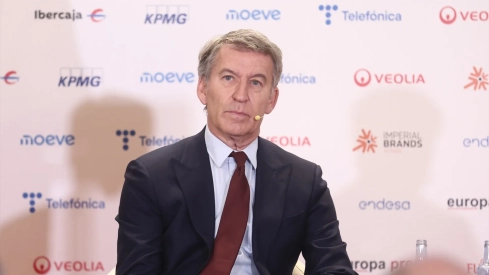
The president of the PP, Alberto Núñez Feijóo, has redoubled his criticism of the Minister of Transport, Óscar Puente, this Tuesday, after the railway accident in Urda, Toledo, and has insisted on calling for his resignation. The popular leader believes that the head of Spanish infrastructure has lost the trust of citizens and has questioned the measures announced by the Government to reinforce the safety of the network.
"Everything he says, unfortunately, has no credibility whatsoever," Feijóo stated in an interview on 'Al Rojo Vivo', on laSexta. The PP candidate for the Presidency has even compared Puente to former minister José Luis Ábalos and has assured that, from a management point of view, he is "a worse minister" than his predecessor.
The statements come almost a week after the collision between a Renfe AVE and an Iryo train stopped on the Madrid-Seville line. The accident on October 28 caused 69 fatalities, all of whom have already been identified, and numerous injuries. The judicial and technical investigations remain open to clarify the causes.
Puente, who retains the confidence of the President of the Government, Pedro Sánchez, has ruled out resigning. This Tuesday, after the Council of Ministers, he presented a package of aid for the victims and a plan for improvements in railway safety. In the afternoon, he is now appearing live at his own request before the Permanent Deputation of the Congress to give explanations about the tragedy.
Feijóo also points to Sánchez
During his interview with Antonio García Ferreras, Feijóo questioned Puente's continued leadership of the ministry after the Adamuz accident, in Córdoba, where 46 people died last January. The president of the PP accused the minister of having generated disinformation about that accident and extended political responsibility to the head of the Executive.
"The most serious thing is that he is still a minister," he said before pointing out that both Puente and Ábalos were appointed by Sánchez. "The real person responsible for all this is the one who appoints him," he maintained.
El binomio Ábalos y Puente como ministros de Transportes demuestra que el verdadero responsable de todo esto es quien les nombra: el señor Sánchez. pic.twitter.com/V5w9vZn2XU
— Alberto Núñez Feijóo (@NunezFeijoo) November 3, 2026
Feijóo has reproached the Minister of Transport for, in his opinion, having dedicated "much more time to social networks than to railway networks and road networks". He has also questioned whether Puente can restore confidence in the system after two serious high-speed accidents in less than a year.
The popular leader has assured that, if he reaches La Moncloa, he will commission an express audit of the network and prioritize the conservation and maintenance of infrastructure. The PP has also demanded that Sánchez appear in Congress to explain the Executive's actions.
His criticisms of Puente join the calls for resignation made in recent days by other political forces. Among them are Frente Amplio, through its candidate Ada Colau, Podemos and the BNG. The minister has defended, for his part, that his way of assuming responsibility is to "face the music" and work to clarify what happened.
Puente's measures and the comparison with Angrois
Before going to Congress, Puente announced after the Council of Ministers a reduction in frequencies on the Madrid-Seville high-speed line when service resumes. The Government has also proposed changes in protocols, technology, security and human resources of the railway network.
Among the announced measures is a double check of decisions in control centers when certain security systems fail. The Executive has also approved a package of aid for the victims of Urda, endowed with 30 million euros, which includes advances and assistance to those affected and their families.
Puente defended his continuity at the head of the ministry this Tuesday and assured that he has not made any decision that has contributed to causing the damage. Last Friday, in an interview on 'Malas Lenguas' on TVE, he admitted that the investigation and analysis of what happened could lead to assessing responsibilities of different people, including himself.
In that intervention, the minister reproached Feijóo for a "double standard" and compared his current attitude with that maintained by the PP after the Angrois accident, which occurred in 2013, when Mariano Rajoy was in government. Puente maintained that at that time the PSOE did not use the victims as a political weapon.
Feijóo rejected that comparison this Tuesday and recalled that Rajoy appeared in the Cortes a few days after the Santiago tragedy, in which 80 people died. "One must be very desperate to bring up the Angrois accident," he replied.
Also asked about the securing of luggage on trains, one of the issues mentioned by Puente, the leader of the PP admitted that the problem had already been raised after Angrois and that it was not resolved during Rajoy's government either. "And there I also include my government. Nothing has been done," he acknowledged.
Puente's appearance before the Permanent Deputation takes place with the Cortes dissolved due to the call for general elections on November 29. The minister attends at his own request to report on what happened and answer questions from parliamentary groups.
