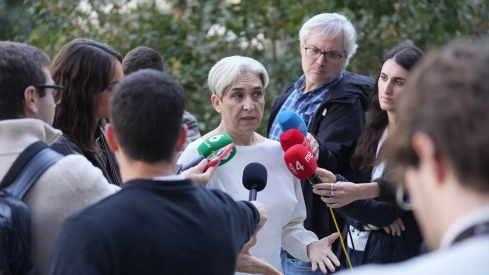
The candidate of Frente Amplio for the general elections on 29N, Ada Colau, has asked the Minister of Transport, Óscar Puente, to explain this Tuesday in Congress what will happen with the high-speed line between Madrid and Barcelona, while reproaching him for having fueled debates that, in her opinion, generate uncertainty.
In an interview on Onda Cero, Colau insisted that the minister must appear to clarify the situation and to answer for the doubts raised around an infrastructure that she considers strategic for mobility.
Request for resignation after the Urda and Adamuz accidents
The leader has also reiterated her request for Óscar Puente to resign to assume political responsibilities for the accidents recorded in Urda and Adamuz, although she clarified that this resignation does not imply pointing out criminal culpability. In addition, she made it clear that her position depends on the position of the President of the Government, Pedro Sánchez.
“Obviously, we cannot impose anything, that depends on the President of the Government and the PSOE, which is the majority force (...) It is not about pointing fingers now, but indeed when not one, but two very serious accidents have occurred in less than a year on the same high-speed section, we do believe that it is good and positive to start rebuilding that trust (...) we believe it is positive that political responsibilities are also assumed, which has nothing to do with culpability, but with political responsibilities,” she stated.
Colau added that she continues to travel by train after the Urda accident and defended that, in a democracy, it is “healthy” to convey a message of “empathy and humanity” when political responsibilities are assumed in the figure of a minister after a tragedy.
Criticism for opening the debate on a possible AVE closure
The Frente Amplio candidate has reproached Óscar Puente for having launched the possibility of closing the high-speed line between Madrid and Barcelona while renovation works are being carried out that, as she recalled, were already scheduled since last year.
Colau asked the minister to explain, during his appearance in the Lower House, why he raised that option amidst the “confusion and pain” after the Urda accident, instead of sending messages of “calm and confidence.”
“Please, let it be done with technical rigor,” she demanded, arguing that, if there really were a technical reason to immediately interrupt a line, the decision should not be subjected to debate, but adopted directly. In her opinion, the way the issue has been raised has increased uncertainty in an “imprudent” manner.
Demand for mobility for Andalusia and a transport plan
Colau also stressed the need to guarantee the mobility of Andalusia, a community whose AVE connection is currently interrupted, and asked for quick work on a transport plan to prevent it from being “isolated from the rest of the country.”
The candidate insisted that the institutional response must focus on restoring user confidence and ensuring immediate solutions for the territories affected by service interruptions.
Railway State Pact and more public leadership
In parallel, Ada Colau has once again proposed a State Pact on railway matters to remove the management of this transport from “partisan struggle” and collectively define a future model, with the necessary investment in maintenance as the central axis.
Her proposal involves articulating a “large public operator,” through the union of Renfe and Adif, with the aim of “cohesioning, having fewer protocols and providing maximum efficiency” to the railway system, which she described as critical infrastructure.
In addition, she defended that it is necessary to “reverse some outsourcing” and “strengthen public leadership” in railway transport, considering that leaving maintenance in a chain of subcontractors “clearly seems not to be yielding good results,” according to what representatives of train drivers and sector workers have told her.
