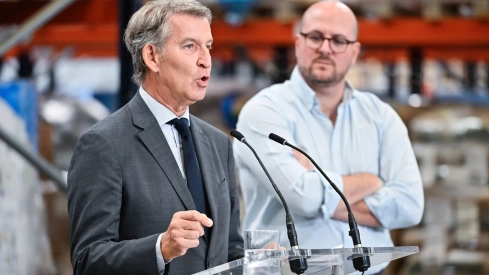
Alberto Núñez Feijóo returned this Thursday to the economic agenda with a shock plan focused on the loss of purchasing power of families. The president of the Popular Party has proposed eliminating VAT on basic foodstuffs, lowering the tax applied to energy to 10%, and temporarily doubling tax benefits per child.
Feijóo presented the measures after visiting a dairy company in Alovera, Guadalajara, accompanied by the president of the PP of Castilla-La Mancha, Paco Núñez. From there, he criticized the Executive's economic discourse and summarized his diagnosis with a particularly harsh phrase. "Sanchismo has turned Spain into an unlivable country. No one can live here," he stated.
The popular leader demanded that the Government abandon "triumphalism" and pay more attention to the cost of filling the fridge, paying for electricity, or facing rent. "People's lives are not measured in statistics, much less in macro figures," he defended. For Feijóo, economic growth loses value when prices increase faster than households' purchasing power.
Inflation reached 4.3% in August, its highest level since February 2023. Food and non-alcoholic beverages rose by 2.3% year-on-year, while transport increased by 9.5% due to rising fuel prices. The economic scenario, however, offers a broader picture than that drawn by the PP. The Organization for Economic Cooperation and Development (OECD) has raised Spain's growth forecast for 2026 to 2.6%, although it also expects an average inflation of 3.7%.
Feijóo has placed the shopping basket at the center of his proposal. The PP wants to apply 0% VAT to milk, cheeses, oil, eggs, fruits, vegetables, meat, fish, and canned goods. These products currently have different rates, so the reduction would have a different effect on each one. Some are taxed at the super-reduced rate of 4% and others bear the reduced rate of 10%.
The second fiscal movement affects energy. The popular party proposes lowering its VAT from 21% to 10% and recovering a reduction that was already in force during the energy crisis. They also propose adapting the Personal Income Tax (IRPF) to inflation to prevent a salary increase intended to compensate for prices from ending up raising the worker's tax bill. "Spaniards are paying inflation twice, once when shopping and again when filing their income tax return," Feijóo assured.
The real scope of tax cuts
The plan dedicates another of its blocks to families with children. Feijóo announced that he wants to double the tax amounts linked to descendants between August and December. For the first child, they would go from 2,400 to 4,800 euros; for the second, from 2,700 to 5,400; for the third, from 4,000 to 8,000, and for the fourth and subsequent children, from 4,500 to 9,000 euros. The supplement for children under three years old would increase from 2,800 to 5,600 euros.
These amounts correspond to the family minimums used to calculate the IRPF. Their expansion reduces the part of income subject to taxation, but it does not mean that the Treasury directly hands over 4,800 or 5,400 euros for each child. The final saving will depend on income, family situation, and the result of each taxpayer's declaration.
The PP calculates that an average family with two children would have about 400 additional euros between August and the end of the year. The party still has to explain the income limits, the number of beneficiary households, and the total cost for public accounts. Feijóo has also not detailed whether the VAT reductions would have a specific duration or what budgetary adjustments would compensate for the loss of revenue.
The third block seeks to reduce the costs for farmers, ranchers, fishermen, and self-employed workers. Feijóo has proposed acting on the price of fertilizers and fuels within the margin allowed by the European Union. In the case of the self-employed, he has revived his proposal to exempt from VAT those who invoice less than 85,000 euros per year, through the application of the European regime for small businesses that Spain still has pending incorporation.
The last part of the plan targets bureaucracy. The president of the PP wants to draw up an inventory of unnecessary state procedures, extend positive administrative silence in certain licenses, and eliminate three regulations for every new regulation approved. "Every unnecessary procedure costs money. Every unnecessary procedure costs time," he stated.
Feijóo has built his discourse on the idea that the Government is using inflation to increase revenue. The PP estimates the increase in tax and social security contributions since 2018 at 180,000 million euros. The comparison also includes seven years of economic growth, job creation, wage increases, and inflation, factors that naturally raise revenue even if tax rates remain stable.
The popular leader has avoided commenting on the eviction of Maricarmen, which has marked political news since Wednesday, and the event held in Alovera ended without questions from journalists. The Deputy Secretary of Institutional Regeneration of the PP, Cuca Gamarra, did express the party's support for the 87-year-old woman and argued that her case makes it necessary to place housing among political priorities.
The PP will take the shock plan to the Congress of Deputies and the Senate. Its absolute majority will allow the initiatives to advance in the Upper House, but the entry into force of the reductions will depend on the support of Congress or on the Government deciding to assume them. The party must now convert Feijóo's announcements into parliamentary texts and accompany them with their corresponding economic report.
Add ElConstitucional.es as a preferred Google source for free.
Stay informed about all the latest breaking news with the best information. Against disinformation, for democracy and social rights.
