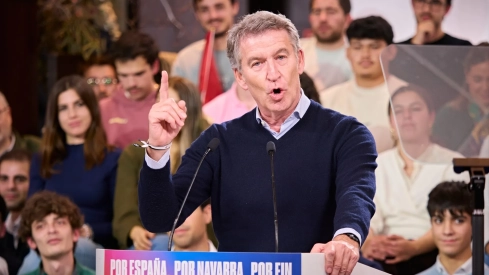
The leader of the Popular Party (PP) and candidate for the Presidency of the Government, Alberto Núñez Feijóo, has defended the possibility of reaching an agreement with Vox after the general elections on November 29 and has rejected the “lessons” from the President of the Government, Pedro Sánchez, after his agreements with Bildu to be invested as president.
In an interview on the podcast El Sentido de la birra, hosted by Ricardo Moya and reported by Europa Press, Feijóo stated that he is not willing to agree with anyone who demands that he “release ETA members with sentences for murders of 100 or 120 years and put them on the street by making a twisted interpretation of the legislation.”
“No lessons on pacts from Sanchismo for me”
Asked about the more liberal electorate and the fear that the PP might give in to Vox on issues such as abortion or euthanasia, the popular leader responded with a question: “What is the alternative?”, and asked if that option involves “asking Bildu for six or seven seats” or the “independentistas”.
“Is the alternative Sánchez's way? It cannot be that the alternative is to agree with all those parties for whom the worse Spain does, the better,” he said, adding that these formations are “blackmailing law by law.” In that context, he insisted that the PSOE and the President of the Government cannot give him “lessons” on pacts: “No lessons on pacts from Sanchismo for me, with all due respect, none.”
Feijóo contrasted his approach with that of Pedro Sánchez and recalled that he, “four votes short of an absolute majority,” said “no” to Junts in 2023.
Euthanasia, abortion, and LGTBI rights, under the PP framework
Regarding possible red lines with Vox, the PP president stressed that his party governs with Santiago Abascal's party in four autonomous communities and that there has been “no problem” in matters such as the abortion law or the euthanasia law.
Feijóo specified that the PP does not share the current euthanasia law and that, if it comes to power, it wants to modify it. This reform, he indicated, could be “a total or partial repeal.” Furthermore, he defended that, along with the regulation of dignified death, there must be “a whole system of palliative care that at this moment in many places in Spain is not deployed.”
He also pointed out that a person who appears to decide to end their life must be “well advised” and “these cases must be monitored to see if it is an irrevocable decision or, on the contrary, it is a decision in the context in which it must be made,” in allusion to what happened in the Noelia case.
In relation to abortion and laws protecting LGTBI groups, Feijóo responded that he can promise voters that these rights will be protected. “I am going to tell voters that any girl in our country who wants to be a mother, we will help her. If after the specific aid she receives, after the intervention that can be offered to her, she continues with her idea of interrupting the pregnancy, if it is within the law, then she will do it,” he declared.
Regarding LGTBI laws, he said he would act “exactly the same” and stated that in the pacts signed with Vox “that issue is not touched.” “That issue is overcome,” he emphasized.
Framework document with Vox and defense of the Constitution
The PP leader explained that his party has established a “negotiation framework” with Vox, referring to the framework document promoted for negotiations in Extremadura, Aragon, Castile and León, and Andalusia, and assured that he will respect it.
“Vox has not presented me with any insurmountable line at this moment,” he stated, before adding that, in those four autonomous communities, Santiago Abascal's party “has not proposed anything” that forces the PP to say “it is not possible.” When a proposal has not been viable, he specified, the response has been immediate: “It is not legal. And if it is not legal, we are not going to do things outside the law.”
Feijóo also maintained that the PP is “the only party that is defending the Constitution at this moment, as is, from the first article to the last final provision.”
“I don't want to be president... at any cost”
The PP leader stressed that he does not want to reach the Presidency of the Government “at any cost” and that, if he wins the elections and can add with Vox, he would not do it “at any cost.”
Furthermore, he indicated that there are still days of campaigning left and defended not making “calculations” before knowing the election results, and recalled that “the Swedes changed 9 points of vote difference in the last 15 days.”
Abascal, ETA, and the rejection of polarization
At another point in the interview, the popular candidate recalled that the PP had already condemned Francoism and that this vote took place “in Aznar's time.” Asked about Vox and the absence of a similar condemnation, he brought up Santiago Abascal's trajectory at the head of NNGG of the PP in Álava and stated that he had suffered “real fascism” with ETA.
“ETA is pure fascism, which is also terrorism, but ETA, when it kills people, is the most execrable thing about a political ideology: killing people for what they think,” he declared. From there, he insisted that he has “no doubts” about Abascal's “democratic origin.”
Feijóo also criticized government laws such as the Trans Law or the only yes means yes law, which he framed within an “ideological” approach, and questioned the effects of the latter by asking how many people convicted of rape or sexual abuse have been released or have had their sentences reduced.
Finally, the PP leader assured that, if he governs, he will try to end the “polarization,” the “trench,” and the “wall” that, in his opinion, Pedro Sánchez has installed, because, he said, Spaniards have to “start talking and conversing again.”
Contact