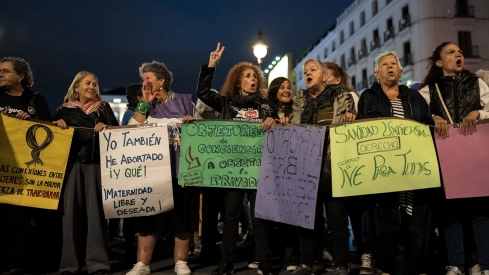
Feminist organizations have called for support for the general housing strike called for next Wednesday, November 11, and have warned that the housing crisis "fuels gender violence."
From the Comisión 8M de Madrid, they argue that the lack of access to a decent home not only hinders economic autonomy but also keeps many women and dissidents trapped in violent relationships, both family and romantic, as they cannot afford the cost of independent housing.
"The housing crisis fuels gender violence. Many women and dissidents remain trapped in violent relationships, family or romantic, because they cannot afford a home. Many others live under the threat of eviction, energy poverty, or residential exclusion. That is also violence," the organization states in its manifesto.
The entity also denounces that the situation generates "anguish" due to the impossibility of making ends meet, "fear" of evictions, and a lack of independence and future, while holding "vulture funds, landlords, and governments that protect the business of a few" responsible for the rising market prices.
"On November 11, we stop because housing is a right, it is not a business or a privilege. Neither houses without people nor people without houses!" the text emphasizes, also criticizing that "while a minority gets rich speculating with housing, the working majority allocates more and more of their salary to rent or mortgage."
In this vein, the Comisión 8M de Madrid calls for a response "with organization and struggle" and stresses that many women do not have housing or live in "shitty" houses, with situations of overcrowding, threats of demolition, or risk of eviction, as occurs in Cañada Real.
Rights, care, and rejection of exclusion based on origin
The organization also insists that "rights do not understand papers or origin" and rejects discourses that seek to divide society "between nationals and foreigners". Against this, it defends that "feminisms respond with solidarity and mutual support" and claims that "no person is illegal, no neighbor is superfluous!".
Its manifesto concludes with a demand for "free lives, vibrant neighborhoods, and decent homes to live in", as well as a collective response to isolation, fear, and lack of alternatives. "They want us isolated, afraid, and without alternatives; they will find us organized, in the streets, and on strike", it states.
The Feminist Policy Forum supports the call
For its part, the Feminist Policy Forum also supports the general strike and warns that "without affordable housing, decent wages, or resources for social rights, there is no equality or freedom for women".
The organization states that the rising cost of living, the loss of purchasing power, job insecurity, and difficulties in accessing decent housing affect the entire working class, but with a specific impact on women, who continue to bear wage inequalities, greater precariousness, more part-time employment, and an unfair distribution of care tasks.
In this context, it demands from employers a "real and loyal" collective bargaining that allows for wage increases, prevents the loss of purchasing power, ends part-time female employment, and promotes company policies aimed at reconciliation.
It also demands an increase in the minimum wage, public sector wages, pensions, and the Minimum Living Income, "in line with the rising cost of living and allowing access to housing." Furthermore, it considers it "essential" to combat the wage gap, the feminization of poverty, and the precariousness that especially affect the most feminized labor sectors.
Rentals, evictions, and women at risk
Regarding the rental market, the Feminist Policy Forum states that prices are "unaffordable" and that they hinder the emancipation of young people, aggravate the vulnerability of older women and single-parent families, and can condemn many women to situations of economic dependence.
Therefore, it demands "decent, public, and affordable housing", protection against evictions, and effective residential alternatives for those who need them, especially for women considered high-risk and affected by gender violence.
The organization warns that, without their own income, sufficient resources, and a safe home, leaving an abuser can be much more difficult. "No woman should have to choose between continuing to live with her abuser or becoming homeless", it emphasizes.
Likewise, it calls for comprehensive protection, local legal advice, if possible in the municipality itself, and psychological care, considering that "gender violence also affects mental health".
Economic autonomy and public care system
Among its demands, the Feminist Policy Forum includes decent working conditions, personal autonomy, and protection against abuse, without origin or administrative status becoming factors of exclusion. It also demands a "sufficient, universal, and quality" public care system.
Finally, the organization advocates for "quality" public residences and co-responsible public policies that allow women to be free to decide about their lives. "We want wages to live, homes to live with dignity, public services that care for us, and time to live. Because no woman has to depend economically on anyone to be free. And because without economic autonomy, without co-responsibility in care, and without lives free of violence, there is no real equality", it states.
Contact