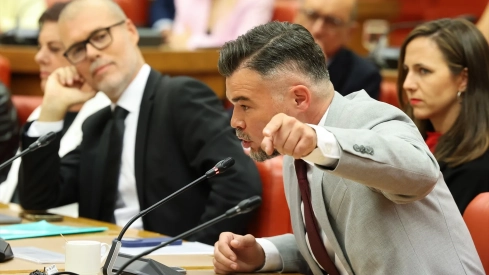
Barcelona, Oct. 19 (Europa Press) - The head of the ERC list for Congress, Gabriel Rufián, has launched a political and organizational message at the same time in his new book, “How to Beat the Fascists” (Now Books), in which he asks sovereignism to assume a more decisive role in the governance of Spain and even proposes that its objective is “to subjugate the PSOE in a PSOE Government”.
The work, which goes on sale this Tuesday, arrives in the midst of the pre-campaign and in a context marked by the early election announced by the President of the Government, Pedro Sánchez, for November 29, as well as by the failure of the left to run in coalition throughout the State. Rufián proposes recovering the formula of the last six years, but with a greater capacity for action and influence from ERC, EH Bildu, BNG and Compromís, in addition to other sovereignist forces, while appealing to the disillusioned left-wing voter.
A call for the political utility of the left
In the 224-page book, the republican leader argues that Catalan, Basque, Galician, Valencian and Andalusian sovereignism must understand that a socialist executive conditioned by sovereignist forces would advance in rights. In this framework, he sets objectives such as holding a self-determination referendum and another on monarchy or republic.
Rufián also demands that the formations to the left of the PSOE share a common program on issues such as housing, security, migration, prices, taxes, corruption and self-determination, “no matter how uncomfortable it may be”, as he writes in the work.
“To militate in utility, not in rhetoric. And to have a plan. The left is not an ambulance that acts in emergencies,” says the ERC candidate a few weeks before the election campaign begins, next November 13.
Among his proposals, Rufián advocates a program based on “working less to work all, producing what is necessary and redistributing everything”, and advocates “intervening in the market” —labor, urban planning and food—, applying taxes on wealth and not on work, and investing massively in education, transport and health.
A review of his origins and personal trajectory
The first pages of the book begin with a look at his biography and his working-class origins. Rufián presents himself with a direct and autobiographical tone: “I come from shit. I was told many times where I thought I was going and that I couldn't. Nobody expected me here.”
The ERC leader also recalls his time in precarious jobs before entering politics and states: “My salary was 1,100 euros. It was that or dismissal. You never knew what would happen. I even stole toilet paper at work and cans at the supermarket.”
Regarding his time in politics, Rufián emphasizes that he lives “from conflict” and acknowledges that his family environment did not want him to dedicate himself to political activity. He also defines politicians as warriors and as salespeople of ideas, and summarizes his vision of the profession: “If you don't fight and you bore, you don't convince; and if you don't convince, you don't win. The rest is philosophy. And being right.”
Message to the ERC leadership and recognition of Joan Tardà
The book also includes a message addressed to the ERC leadership, to whom Rufián asks that “whoever shows their face must have means and command”. In the same vein, he warns that party apparatuses must understand that charisma and electoral assets are elements that must be cared for and promoted, because “they are not bought in pharmacies”.
The republican leader also argues that not only those who behave best should lead, but those who do it best, and criticizes that leveling down, under the pretext of false equanimity, ends up rewarding flattery over talent.
In another passage, Rufián apologizes to his predecessor as ERC spokesperson in Congress, Joan Tardà, whom he describes as a key reference in his career. “I was a bastard,” he admits, before defining himself as a disastrous, selfish and arrogant assistant. “He put up with unbearable things from me. Because I knew nothing and thought I did; he, on the other hand, knew everything and didn't say it. If I'm here, it's undoubtedly because of him,” he points out.
Rufián adds that, if Tardà had had an ounce of ambition, he would have become president of the Generalitat or wherever he wanted.
Criticism of Junts and defense of a moderate Catalanism
In the final section of the book, the ERC list leader argues that Catalonia needs Junts to stop harming it with its votes and speeches, and asks it to return to moderate and dialoguing Catalanism. “Let it stop imitating Orriols to return to Pujol,” he demands.
Rufián also believes that Junts needs a period of reflection so that different leaderships can emerge and recover “a more normal Convergència,” a right-wing party that, he suggests, is capable of isolating fascism.