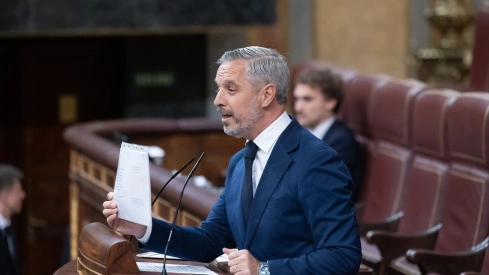
Juan Bravo, Deputy Secretary of Finance, Housing, and Infrastructure, has praised the plan of the leader of the Popular Party, Alberto Núñez Feijóo for Ceuta, in conjunction with the president of Ceuta, Juan Jesús Vivas. “It is a plan that covers the entire scope of the needs of two cities as important for Spain as Ceuta and Melilla,” said Bravo.
Commenting on said plan, he emphasized that “there is a very important economic part” in Feijóo’s proposal. “We have seen the weakness of the border both in infrastructure, as in technological means, as in legal issues.” He also remembered the work of the police and civil guards who work in the city, and denounced the ways in which they have to work, "these are two demands that have been going on for years and have never been addressed, despite the fact that they are our Security Forces and Corps."
Touching on all topics, he also recalled the housing problems in the autonomous cities, adding that, "it requires a decisive commitment from the Government of Spain to guarantee that people who want to go to Ceuta and Melilla can have a place to live." Bravo emphasizes the PP's plan to extend the Social Security bonuses existing in Ceuta and Melilla, which the Government wants to eliminate at the end of the year: "This Government removed that bonus, then reinstated it, then modified it again and, in principle, they end on December 31."
Regarding the Government's actions, according to the deputy secretary, he denounces that the Government has not contacted the PP to discuss economic measures in Ceuta: "The Government does not call us. The Government does not want a plan. We do understand that this economic, social, and legislative response is necessary for the problems we have seen that have occurred and are occurring in Ceuta and Melilla." He also touched on the issue of migrants who still persist in Ceuta. "If the European Union has said it, if Morocco has said it, and if Albares and Maslaska said that all those who had entered would be returned, what is surprising is that it is not happening."
On this topic, they also highlight that there is also a certain lack of knowledge about the exact data of the migrant people who are still in Ceuta: “We estimate between 10,000 and 12,000. There are other gentlemen who go so far as to say 20,000... and the Government does not give any figure.” Given this, he wanted to send a final message: “We have no data. Would you send your children to school under those conditions? Would you open your business under those conditions? Or would you invest or bet on the city under those conditions? That's what we know. The Government tries to deflect responsibility,” he concluded.
