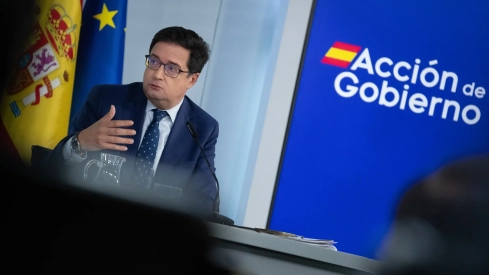
The Government has raised its tone this Thursday against Alberto Núñez Feijóo after the leader of the Popular Party demanded from Ceuta the expulsion of all people who entered irregularly from Morocco, including minors. Minister Óscar López has accused the opposition leader of causing "vicarious embarrassment" and of having adopted a discourse that is now "impossible to distinguish" from that of Vox's far-right.
The Minister for Digital Transformation and Public Function defended in an interview on 'TVE' that Spain can protect its borders and territory while respecting international law and human rights. "That is what Mr. Feijóo and this right-wing gone wild, absolutely incapable of distinguishing itself from Vox, do not understand," he reproached.
Feijóo presented seven measures on Wednesday that he considers "essential" to respond to the crisis. Among them are the creation of a single command, voluntary return or expulsion of all people who entered on July 30, and greater reciprocity in relations with Morocco.
Óscar López believes that the popular leader took advantage of his appearance with Juan Jesús Vivas to "scratch a handful of votes with misfortune". He also accused him of going to Ceuta to offer a rally while the Government works with the regional executive, Morocco, security forces, and social entities deployed in the city.
"The priority must be to restore normality to Ceuta and to do so by guaranteeing human rights and international legality," the minister defended. López admitted that institutional coordination can be improved, although he called for efforts to be concentrated on reception, healthcare, and the protection of the most vulnerable people.
The Government warns that minors cannot be expelled en masse
The Government spokesperson and Minister of Inclusion, Social Security and Migrations, Elma Saiz, has recalled that the situation of each minor must be studied individually, with the intervention of the Public Prosecutor's Office, a hearing of the affected party, and guarantees regarding the conditions under which a possible return would occur.
Saiz has asked the PP if it intends to "break the law" or ensure that "Spain ceases to be a State of Law". The best interests of the child, she insisted, must be placed above any electoral calculation and the demands of an immediate return.
Spanish legislation rules out collective expulsions of children and adolescents. Family reunification can be agreed upon when the family is identified and there are sufficient guarantees, but each case must assess the minor's personal circumstances, their safety, and the conditions to which they would return.
The Minister of Youth and Children, Sira Rego, already described on Wednesday as "barbaric" to talk about deporting children. Her department is preparing, together with Ceuta, the urgent transfer to the Peninsula of 500 especially vulnerable girls and adolescents so that they can receive accommodation, protection, and specialized care.
The Executive has enabled new temporary spaces with capacity for 1,800 people and has begun to transfer those who remained in improvised settlements to them. Arcadi España has estimated the budget allocated to caring for minors at 25 million euros and the resources directed to social organizations working on the ground at 6.5 million.
The socialist spokesperson in Congress, Patxi López, has accused Feijóo of traveling to Ceuta to "sow discord", seek a permanent confrontation with the Government, and fuel "discourses of fear and hatred". In his opinion, some of the responses proposed by the PP are legally unviable and leave out of the debate the vulnerability of unaccompanied minors and girls exposed to mafias, sexual violence, or exploitation networks.
The clash reaches the Supreme Court over appearances
The dispute has also moved to the Senate. The PP has filed an appeal before the Third Chamber of the Supreme Court after Fernando Grande-Marlaska, José Manuel Albares, and Margarita Robles did not attend the appearances called by the popular majority to explain the management of the crisis.
The ministers are scheduled to appear starting next week in Congress. The Government maintains that the Senate summonses were set without agreeing on the dates in the Bureau and the Board of Spokespersons or taking into account their agendas, while Feijóo defends that attending the Lower House does not exempt them from accountability to the Upper House.
"What the PP and Mr. Feijóo are doing with the Senate is embarrassing," Óscar López has stated, accusing the popular party of using its absolute majority to delay laws and promote commissions with a partisan purpose. He also recalled that the PP rejected Mariano Rajoy's appearance in the 'Gürtel' case on about twenty occasions.
The appeal requests urgent precautionary measures for the Government to cease its refusal and organize the pending appearances before the end of August. The Supreme Court must now decide whether to intervene in the open struggle between the Executive and the PP's absolute majority in the Senate.
