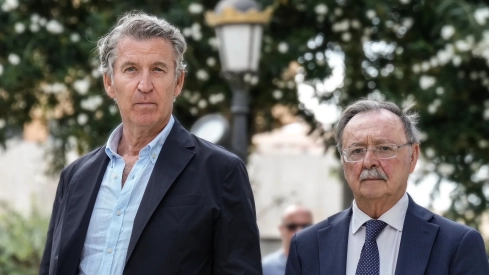
Alberto Núñez Feijóo announced this Wednesday from Ceuta that the Popular Party will take to the Supreme Court the refusal of several ministers to appear in the Senate to explain the management of the crisis opened after the massive entry of migrants on July 30 and 31. The opposition leader wants the High Court to determine whether members of the Executive can reject summons from the Upper House, arguing that they will offer their explanations before Congress.
"The Government cannot decide in which Chamber it appears, nor when it does so, nor under what conditions it accepts to be controlled," Feijóo defended during his second visit to the autonomous city since the beginning of the emergency. Accompanied by the president of Ceuta, Juan Jesús Vivas, the popular leader accused the Executive of treating what happened as "a simple summer episode" and demanded exceptional measures in a situation he considers far from resolved.
Feijóo assured that since July 30, Spain "lost control of one of its borders" and described the massive entry as an "invasion." He also placed the number of migrants who would remain in the city at at least 10,000, a figure that the Government has not confirmed. Vivas himself has reproached Moncloa for not yet having offered a precise balance of the people who remain in Ceuta.
The PP opens the way to the Supreme Court
The president of the PP explained that his party will use "all available instruments" to enforce what it considers a constitutional obligation. "We have found ourselves obliged to go to the Supreme Court," he stated, before insisting that the future presence of ministers in Congress does not exempt them from also responding before the Senate.
The rejected summons affected the Ministers of Interior, Fernando Grande-Marlaska; Foreign Affairs, José Manuel Albares; and Defense, Margarita Robles. The Executive has argued that its officials will offer explanations next week in the Lower House, within a calendar that includes the appearance of seven ministers. The PP considers this response insufficient because the Senate demanded their presence before the Government set the dates for Congress.
To this offensive will be added the requests for censure that the popular party will take to the first plenary session of September against Marlaska, Albares, Robles, the Minister of Health, Mónica García, and the Minister of Equality, Ana Redondo. Feijóo has accused the Government of failing to protect the more than 80,000 Spaniards living in Ceuta and of leaving "to their fate" thousands of migrants, some of them without stable accommodation or regular access to food.
The popular leader has also closed ranks with Vivas in the face of criticism launched from several ministries against regional management. "It is an absolute disgrace to hold the most responsible person responsible," he declared. According to Feijóo, the president of Ceuta has been "showing his face, without losing his composure and without excuses" for three weeks, while taking on tasks that correspond to the State.
The seven measures proposed by Feijóo
The first proposal of the PP president consists of establishing a single state command to coordinate the response in Ceuta until normality is restored. Feijóo has also demanded the convening of the National Security Council and the incorporation of all necessary officials, interpreters, and specialists in immigration to process pending files.
His second measure involves the voluntary return or expulsion of all people who entered irregularly during the crisis. "When I say all, I mean all," he emphasized. Feijóo wants the Government to establish a calendar to complete the procedures within one month and rejects that those who participated in the massive entry can obtain rights due to that circumstance.
The third point proposes rebuilding relations with Morocco based on "respect and reciprocity". Feijóo has accused the Government of practicing "secret diplomacy" with Rabat for years and of subcontracting the control of the southern border to the will of the neighboring country. His intention, he assured, would be to maintain a relationship of friendship and cooperation without accepting challenges to Spanish sovereignty.
The fourth measure demands the use of available Spanish and European instruments. The popular leader mentioned the European Union's Crisis Regulation, the presence of Frontex, border control procedures, and the accelerated processing of asylum and return requests. "Everything exists, everything is available, and nothing has been used," he maintained.
Feijóo has also promised to guarantee the inviolability of the border through more infrastructure, human resources, and legal reforms. Among them, he cited changes in the Immigration and Asylum laws to extend border rejection to entries made by sea. "One thing is to ask for protection through the door and another to kick the door down," he stated during his speech.
The sixth point seeks to strengthen the European recognition of Ceuta and Melilla. The PP will work to ensure that both cities have their own representation in the European Committee of the Regions and receive similar treatment to other territories far from the continent. The last measure consists of a reactivation plan endowed with at least 650 million euros over the next six years, with public investments, improvements in connection with the Peninsula, business incentives, and actions against youth unemployment.
Feijóo's most forceful position came when addressing the future of minors. The popular leader has rejected the transfer to the Peninsula of about 500 especially vulnerable girls that the Ministry of Youth and Childhood is working on. "What is happening in Ceuta that they have to be transferred? And the girls who were born in Ceuta and are Spanish, who protects them?" he asked. The Vivas Government has accepted the transfer as an extraordinary measure, although it maintains repatriation to Morocco as a general criterion.
The return of minors, however, requires an individualized procedure. Article 35 of the Immigration Law establishes that any repatriation must respond to the best interest of the minor and be carried out through family reunification or delivery to protection services that offer adequate guarantees. The consideration of Morocco as a safe country also does not allow for a collective and automatic return. The European Pact on Migration and Asylum maintains specific safeguards for unaccompanied minors and excludes them from the border procedure unless they represent a security threat.
Vivas asks to "take Ceuta out of the ICU"
Juan Jesús Vivas opened the appearance by denouncing that the feeling of abandonment among Ceutians remains "fully justified." The city president accused the Government of not having contained a march that he placed at 80,000 people and of disregarding his repeated requests for "help and succor".
Vivas has questioned the government's discourse on the return to normality. According to his denunciation, twenty days after the massive entry, it is still unknown how many people remain in Ceuta, there is no temporal horizon to resolve the crisis, nor has a concrete legal initiative been announced to expedite returns. "It is impossible for there to be normality when a Ceutan does not recognize Ceuta as it is," he lamented.
The popular leader has requested more agents, civil servants, judges, prosecutors, and interpreters, as well as a permanent presence of Frontex in Tarajal. His proposal also includes repairing the damages caused, recovering economic activity, and approving a regulatory framework that prevents the use of migratory pressure to destabilize Ceuta or question its sovereignty.
"Ceuta's security must be guaranteed by the State, but it must be strengthened, and greatly, through Europe," Vivas defended. The Ceutan president has demanded specific treatment for the city and warned against dependence on Morocco. "The Government continues to trust the neighboring country to guarantee our territorial integrity, and everyone knows what the neighboring country thinks of our sovereignty," he pointed out.
Vivas has asked to avoid the electoral use of the crisis, although he has defended his obligation to demand accountability. "It is not legitimate to try to gain any political advantage from this existential crisis," he stated before demanding that the Government fulfill its constitutional powers and launch the necessary plan to "get Ceuta out of the ICU."
The Ceutan president finally thanked Feijóo for his personal support and assured that he has called him every day since the beginning of the crisis, sometimes up to three times during the same day. "Do not forget that of all things, the most important are Ceuta and the Ceutans," he recounted that the PP leader conveys to him in those conversations.
