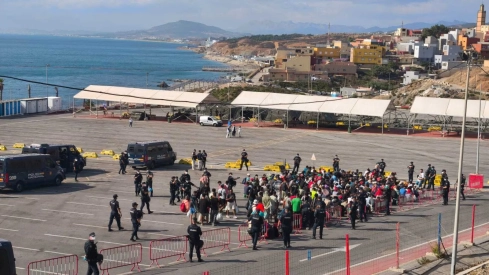
Since the end of July, after the massive arrival of people in Ceuta through the border with Morocco, hundreds of migrants have remained in precarious conditions in different parts of the city. On Trampolín beach, some even began to build an improvised settlement on their own due to the lack of a place to stay.
Given this situation, the Government has launched a plan to offer temporary accommodation to some 1,800 people who are currently homeless. The transfers began early this Thursday and are being carried out voluntarily, as part of an operation coordinated between the State Security Forces and Corps and the Government of Ceuta.
The first facilities enabled are in Loma Margarita and El Embolsamiento. The Executive plans to progressively expand these spaces as the conditioning work on other locations is completed. The measure aims to prevent these people from having to continue spending the night outdoors, both on public roads and on Trampolín beach itself, where one of the main improvised settlements had been consolidated.
500 minor girls transferred to the Peninsula
The central Government and the Autonomous City of Ceuta have activated an urgent plan to get around 500 minor migrant girls off the streets and subsequently prepare their transfer to the Peninsula. The Ministry of Childhood and the Ceuta authorities have launched a first phase of the operation, which includes their provisional reception in six different spaces.
Among the planned locations are a warehouse that has already started operating, two other spaces still pending conditioning, a celebration hall with capacity for 120 people, and two residential buildings that can house 70 and 80 minors, respectively. The first displacements to these points have already begun.
The operation also has the support and protection of neighborhood associations, among them the association El Príncipe. Meanwhile, technicians maintain their estimate on the total number of minors present in Ceuta and point out that they would not exceed 3,000. Sources from the Ministry explain that the objective is to apply a reception model that does not directly depend on the autonomous communities, similar to the one used to transfer asylum-seeking minors from the Canary Islands. These resources are managed by specialized entities and allow transfers to be carried out without the communities having to assume the guardianship of the minors.
