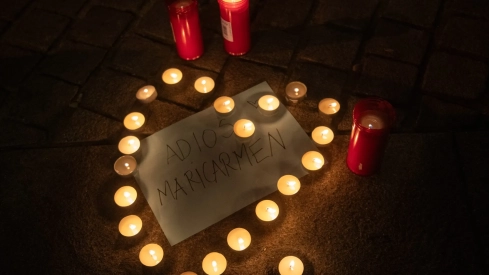
The death of Maricarmen has turned the Puerta del Sol into a place of mourning, but also of vindication. The 87-year-old woman, whose eviction from the home she had resided in for seven decades triggered a wave of mobilizations for the right to housing, passed away this Wednesday and her death caused a spontaneous vigil among the participants of the Madrid encampment, which this Thursday reaches its twelfth night.
The news spread during the early hours among the people who remain installed in the central square. Huddles followed around the tents while the visibly affected protesters tried to assimilate the death of someone who had become one of the main symbols of the protest.
As the hours passed, sadness gave way to various tributes. Improvised altars were set up both next to the Real Casa de Correos, headquarters of the Government of the Community of Madrid, and in the vicinity of the Bear and the Strawberry Tree statue or in the Congress of Deputies. Candles, flowers, posters, and farewell messages began to occupy different points of the square.
A vigil marked by slogans and candles
After the death was announced, the participants in the encampment began to chant various slogans related to the right to housing. Among them were heard "They are not deaths, they are murders," "We will not tolerate one more eviction," "This is class struggle and we cannot make peace," or "Fight, fight until victory."
In the midst of the concentration, the spokesperson for the Student Union Carlos Ochoa called for maintaining the mobilizations and claimed that the continuity of the protest is, in his opinion, the way to pay tribute to Maricarmen. "The best tribute we can pay her is to continue with the struggle," he stated. "We are not going to stop, we are going to continue," he added.
Subsequently, a part of the protesters moved from Sol towards the vicinity of the Congress of Deputies, accompanied by agents of the National Police. The march reached Cedaceros street, where the participants stopped to observe a minute of silence and remained seated on the asphalt, with candles and banners.
The protest now looks beyond Maricarmen's case
The death of Maricarmen occurs while the encampment maintains its demands for housing and as social movements prepare new mobilizations. Among them is the general strike for housing called for next November 11.
The protesters believe that the proposed measures alone do not solve the problem. Rubén, one of the participants in the encampment, insisted that the mobilization cannot be limited to the case of the 87-year-old woman. "Joint solutions need to be found, this is not an encampment just for Maricarmen, but for the entire situation we are all generally experiencing," they defended.
The encampment, therefore, faces its next days with Maricarmen's death becoming one of the central elements of the protest, but with participants insisting that the demands transcend her personal case.
Flowers and messages outside the house where she lived for seven decades
The tributes were not limited to Puerta del Sol. During the day, dozens of people also traveled to Alcalde Sainz de Baranda street, where the building in which Maricarmen lived for more than 70 years is located.
At the doors of the building, another altar was improvised with candles and flowers. Among the messages left by those who came to say goodbye, phrases such as "Thank you for changing Spain" or "We will fight for you" can be read.
The Madrid Tenants' Union also left different objects to remember Maricarmen, including t-shirts and posters with the slogan 'Maricarmen stays in our hearts'.
The property was Maricarmen's home until last September 23, when the eviction was carried out despite the presence of neighbors and activists who tried to prevent the eviction. After leaving the home, the woman was transferred to Gregorio Marañón Hospital due to her delicate state of health.
Finally, she passed away this Wednesday at the age of 87. Her death has left an image of mourning in the two places that have marked the last weeks of her story: the home she had to leave and Puerta del Sol, where her case ended up becoming one of the main symbols of the protest for the right to housing.
