
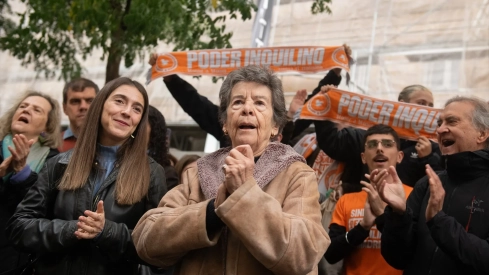
Maricarmen has been, and will be, a symbol of struggle. At 87 years old, she managed to mobilize and move an entire country around a claim as basic as being able to live with dignity in what had been her home for more than seven decades. Her story ceased to be the story of a woman facing an eviction to become the reflection of a problem that affects thousands of people.
From this newspaper, we want to extend our condolences to her family, her friends, her lawyer, and the Madrid Tenants' Union, which accompanied her during the last months of her life.
Maricarmen turned her eviction into a symbol. At 87 years old, she was able to stand up to a system that, for years, has allowed the price of a home to be increasingly out of reach for those who need a home to live in. Her case has brought to the table the debate on rents, speculation, evictions of vulnerable people, and the need to guarantee the right to decent housing.
"If they are going to cut my throat, it will be fighting, not sitting in an armchair or leaving at night with a suitcase. I can't stand the harassment anymore," she claimed in one of her first eviction attempts.
Those words were not a political slogan. They were the words of an 87-year-old woman who did not want to leave the house where she had lived for 71 years. Her eviction, last September 23, caused a wave of mobilizations and turned her name into one of the main symbols of the housing protest in Spain.
Maricarmen paid 500 euros in rent before Urbagestión bought her home and raised the rent price to 2,650 euros. Her lawyer explained to this newspaper that during the weeks of conflict, different alternatives were considered to prevent her from having to leave her home, including the possibility of covering the difference in rent.
But the real estate company refused all possibilities to stop her eviction.
Maricarmen left her house on a stretcher and was transferred directly to the Gregorio Marañón Hospital, where she remained hospitalized until her death. Finally, under social pressure, Urbagestión accepted that the woman would return to her home. The solution came late. Maricarmen was already hospitalized and, finally, died without being able to return to the place where she grew up.
Her story has had consequences that go far beyond her own case. Her name has been linked to the protests, to the Puerta del Sol encampment, and to the Pedro Sánchez Government drafting two housing decrees to prohibit evictions of vulnerable people, stop speculative purchases, or set limits on rent price increases.
Some of these measures have met parliamentary opposition. PP, Vox, and Junts have rejected the PSOE and Sumar decrees, and now it will be up to the Permanent Deputation to decide on their validation or repeal.
Maricarmen has also managed to put the housing problem at the center of the electoral pre-campaign. She ended up turning an individual battle into a collective demand. She made visible her situation and that of thousands of people who are evicted in Spain.
The spokesperson for the Madrid Tenants' Union, Alicia del Río, expressed through tears after learning of her death: "Today rentism has finished killing Maricarmen." Del Río added that "speculation and rentism kill people every day in the country" and that, with each eviction burofax and each rent increase, the health and lives of those who suffer these situations are put at stake.
The protesters in Sol, upon hearing the news, shocked, dedicated minutes of silence to her. Political figures have joined these condolences.
However, in contrast to messages of respect, there are those who have used Maricarmen's death to spread their hatred.
"They have killed Maricarmen. Without any scruples, they have used the suffering of an elderly person to mount a campaign that would hide the Government's responsibility for the housing disaster. The responsibility of Pedro Sánchez, as Maricarmen said. Let it be known who has brought ruin and death (in the blackout, in the DANA, in Adamuz, in Ceuta) to Spain," the Vox ultras have written on their social networks.
The PP in the Madrid Assembly has vetoed a minute of silence in the Plenary, considering that it could contribute to a political use of her case. "We don't see it," they have conveyed.
Alberto Núñez Feijóo, for his part, has extended his condolences to the family and has avoided "more stones in the wall" and an "interested use" of the case. "Neither campaign, nor parties," he wrote, before concluding: "In the face of a person's death, only respect is appropriate."
Maricarmen was an 87-year-old woman who asked to be able to stay in her home. She was a woman who refused to leave in silence.
She was a woman who got thousands of people to take to the streets and who made the housing problem the center of the national debate.
Maricarmen could not return home. But her fight can continue. For her. For those who stood by her side. And for the thousands of people who continue to face the housing problem every day.
Maricarmen, the fight continues.
