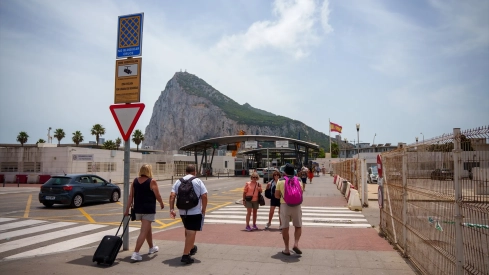
The European Union and the United Kingdom will formalize this Tuesday in Brussels the agreement that will regulate Gibraltar's relationship with the community bloc after Brexit, a pact that will mark the beginning of a new stage at the border between Spain and the Rock. Its provisional application will begin on July 15, from which date the Fence will disappear as a border control point.
The signing will take place in the Belgian capital and will be attended by European Commissioner Maros Sefcovic, responsible for the negotiations on behalf of the European Commission, and the British Minister of State for Europe, Stephen Doughty. The Spanish Minister of Foreign Affairs, José Manuel Albares, and the Chief Minister of Gibraltar, Fabian Picardo, who have accompanied the negotiating delegations throughout the process, will also attend the event.
With the provisional entry into force of the agreement, passport controls will no longer be carried out at the land border and will move to Gibraltar airport. A double control system will be established there, involving both Gibraltarian authorities and the Spanish National Police.
The President of the Government, Pedro Sánchez, will travel on Wednesday to La Línea de la Concepción, accompanied by Albares, to stage the beginning of this new stage and the disappearance of the Fence, one of the main symbols of the border between Spain and the British territory.
"A new era of opportunities"
Before the signing, Albares defended that the agreement represents "a historic stage for Spain, for Andalusia, for the Campo de Gibraltar", in addition to representing "a new era of opportunities" for both sides of the border. The minister also maintained that the pact allows "finally closing Brexit", by resolving the last major pending issue derived from the United Kingdom's departure from the European Union.
For its part, the Government of Gibraltar plans to present in the coming days to its Parliament the so-called "concordat" with the United Kingdom, a mechanism that will regulate the application of the agreement and that, as Fabian Picardo has advanced, contemplates the possibility that Gibraltarian citizens decide by referendum whether they wish to end the pact in the future.
A barrier that marked several generations
Installed in 1909, the Gibraltar Fence has survived a century of diplomatic tensions, a total closure under Francoism, and a progressive reopening that was not completed until 1985. When the United Kingdom installed it, its function was simply to control access to the territory. Over the decades, it acquired a political charge, fueled by the historical disagreement between Spain and the United Kingdom over the sovereignty of the Rock.
The episode that turned it into an international symbol came in 1969, when Francisco Franco's regime ordered the complete closure of the land border, after Gibraltarians rejected passing to Spanish sovereignty. The decision left the territory isolated for thirteen years and affected thousands of workers and families from the Campo de Gibraltar who depended on the daily relationship with the Rock. In 1982, a partial opening for pedestrians was carried out, although circulation did not return to normal until February 1985.
