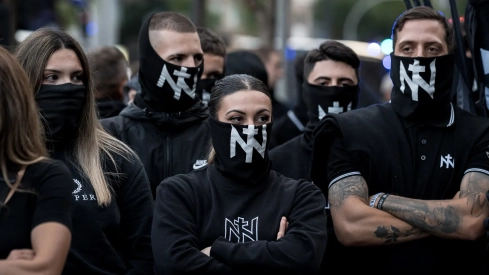
There are stories that seem taken from a series, but that happen much closer than we think. In Spain, a group of young people dressed in black, with a paramilitary aesthetic and radical speeches, has gone from organizing online to starring in a national judicial investigation. Its name is Núcleo Nacional and, in recent days, it has once again made headlines.
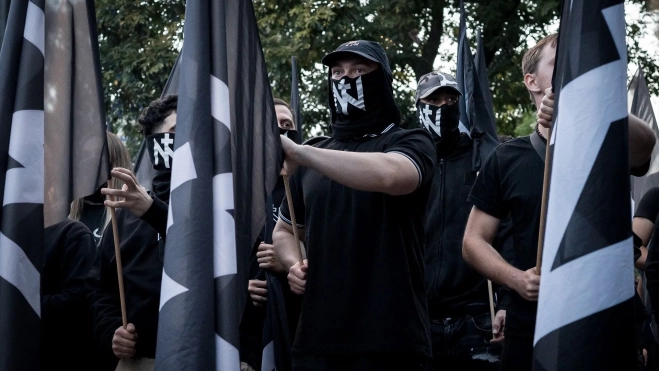
The organization, linked to neo-Nazism and the far-right, is at the center of an investigation for alleged hate crimes, illicit association, and possession of weapons. The police operation on November 6 ended with 14 arrests in seven Spanish provinces. Among them was Isabel Medina Peralta, one of the most recognizable faces of the movement. But who are they really? How was this group born? What role has Peralta played in its growth? And, above all, why does their story so closely resemble that of 'Salvador', the Netflix series that delves into the world of neo-Nazi groups?
From the Ferraz protests to an organization with its own structure
To understand the birth of Núcleo Nacional, one must go back to November 2023. Spain was then going through a period of strong political tension due to the negotiations of Pedro Sánchez's Government with the pro-independence parties to pass the amnesty law. During those weeks, the national headquarters of the PSOE, located on Ferraz street in Madrid, became the scene of numerous concentrations and protests. Among the groups that began to coincide in those mobilizations were young people linked to different far-right organizations.
It was in that environment where what would later be known as Núcleo Nacional, which initially used the name Noviembre Nacional, began to take shape. Its Telegram channel started operating in January 2024 and its public presentation took place on April 14 of that same year. Behind its creation were, among others, the brothers Iván and David Rico Olivares. Little by little, the movement gathered people from other ultra groups and built its own identity, based on a very recognizable aesthetic: black clothes, covered faces, bodybuilding, Nazi-inspired symbolism, and carefully prepared videos to be disseminated on social media.
Its discourse also left little room for interpretation. The organization spread ultranationalist, racist, and anti-immigration messages, as well as homophobic and anti-democratic stances. Among its slogans is "Blood, soil, and tradition," a slogan that researchers link to supremacist ideas. Over time, Núcleo Nacional ceased to be solely an internet group and began to organize events, open headquarters, and establish contacts with organizations of similar ideology in other European countries.
One of its main meeting places was 'El Nido' (The Nest), a venue located in Madrid that had a gym, meeting rooms, and spaces for its activities. The police investigation has also identified an internal structure divided into departments and a leadership known as 'La Cúpula' (The Dome). Its intention to enter politics was also no secret. In February 2026, they registered a political party under the name of Noviembre Nacional. According to investigation information published by Cadena SER, this decision also responded to the fear that the association could end up being outlawed. Its leaders believed that a political party would have greater legal guarantees against a possible prohibition.
Isabel Peralta, the most known face and a family history linked to politics
If there is one name that is repeated when talking about Núcleo Nacional, it is that of Isabel Medina Peralta. She is 25 years old and has been linked to far-right movements for years. Before becoming one of the most visible figures of Núcleo Nacional, she was part of Bastión Frontal, another youth organization with a fascist ideology. Her leap into media attention came in 2021, when she participated in a tribute to the Blue Division in the Almudena cemetery in Madrid. During her speech, she delivered an anti-Semitic discourse that generated enormous controversy.
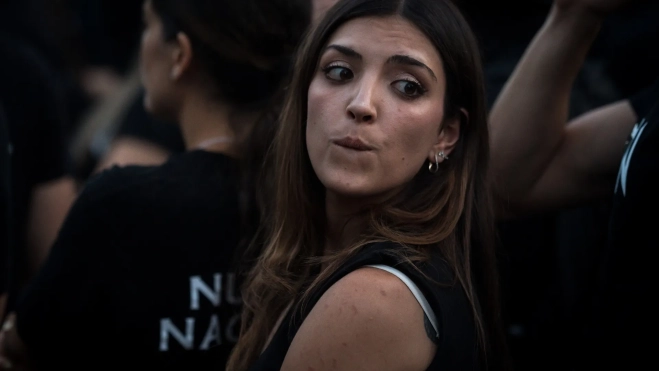
That episode was not the only one that brought her before the courts. Peralta was sentenced to one year in prison for a hate crime related to a speech against the Moroccan immigrant population, although the conviction was not yet final according to the information published about the case. Over the years, her presence on social media and at the organization's events increased. In Núcleo Nacional, she would have performed functions related to propaganda and international relations, in addition to becoming one of its main spokespersons.
Her arrest last November 6 once again placed her at the center of current events. According to information published by EL PAÍS based on the judicial summary, investigators found a significant arsenal of weapons in her home, including ten rifles, three shotguns, and three pistols. Conversations attributed to Peralta have also been published in which eugenic and supremacist plans are discussed. But her family history has also aroused interest. Her father, Juan Manuel Medina, was a councilor for the Popular Party in Seseña (Toledo) and, according to published information about his career, had previously been with Falange and España 2000. Isabel herself recounted in 2021 that her father had kicked her out of the house because of her ideas.
'Salvador', when reality approaches fiction
What happened with Núcleo Nacional also allows us to revisit a series that arrived on Netflix in February 2026: 'Salvador', starring Luis Tosar and Claudia Salas. The fiction, created by Aitor Gabilondo and directed by Daniel Calparsoro, poses a situation that serves to approach an uncomfortable reality: what happens when a young person ends up becoming part of a neo-Nazi group?
The story follows Salvador Aguirre, an ambulance driver who discovers that his daughter belongs to an ultra-organization called White Souls. The young woman defends racist, violent, and homophobic ideas, completely opposite to the values her father had tried to instill in her. From that moment on, Salvador tries to understand how his daughter ended up in that environment and what is behind her radicalization. To do this, he will have to approach a world that until then was completely alien to him.
Although 'Salvador' is a work of fiction and White Souls is not Núcleo Nacional, both stories allow us to put on the table issues that go beyond a specific organization: the recruitment of young people, propaganda on social networks, the construction of a collective identity, and the normalization of extremist discourses. Reality and fiction are not the same, but they share a fundamental question: how certain groups manage to attract young people and turn radicalism into a form of belonging. And while the series invites reflection from the couch, the investigation into Núcleo Nacional reminds us that this phenomenon also has a real dimension in Spain.
Contact
We are listening. Get in touch.
