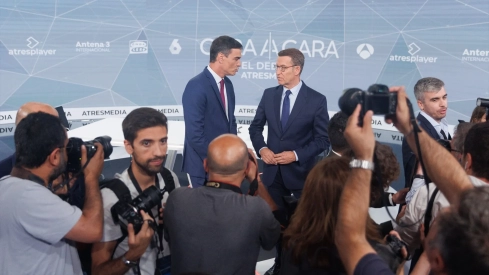
Pedro Sánchez accepted this Thursday a 'face-to-face' with Alberto Núñez Feijóo on Monday, November 16, but the agreement on electoral debates still has an important issue to resolve. The PSOE wants the four-way meeting with the candidates from Vox and Frente Amplio to be held on Thursday, November 26, on TVE, while the PP had placed that event on Atresmedia. The socialists demand both formats and reject that public television be left out of the debates between the main aspirants to Moncloa.
Ferraz's response brings positions closer on dates, although the channel for the Sánchez-Feijóo duel remains open. According to 'ElConstitucional.es' from Atresmedia sources, the group wishes to organize that meeting, but still does not know if it will be in charge of doing so. The option of Mediaset also remains on the table, whose invitation the PP had already accepted. The socialist statement refers to "private media," without assigning the debate to either of the two operators.
The PSOE proposes repeating the scheme of the general elections of July 2023, with a meeting between the two main candidates on a private television at the beginning of the campaign and another plural one on public television during its final stretch. "It is essential that both meetings take place," maintains the socialist leadership, which considers that there must be "at least" those two opportunities to confront the electoral projects before November 29.
The disagreement is on public television
The PP's proposal distributed the three major events among the main audiovisual groups. Feijóo had accepted the Mediaset 'face-to-face' for November 16, a debate of parliamentary spokespersons on RTVE on Monday 23, and another among the four main candidates on Atresmedia on Thursday 26. The discrepancy with the PSOE especially affects this last meeting. The popular party reserved the spokespersons format for the public corporation, while Ferraz also demands the presence of the leaders.
The initial offers from the networks had different schedules. RTVE proposed a Sánchez-Feijóo duel on the 17th, the meeting of the eight parliamentary groups on the 23rd, and the four-way debate on the 26th. Atresmedia originally proposed gathering the four candidates on the 18th and holding the 'face-to-face' on the 23rd. These are proposals that have been crossing paths with the parties' preferences, so the agreement between PSOE and PP on certain dates still requires closing the organization with the media.
Ferraz has responded with an express warning about TVE. "The PSOE will not veto any private channel, just as we will not consent, under any circumstances, to the veto of public television," states their communiqué. The socialists ask that the groups agree to share the live signal, so that the meetings can be seen on all interested channels. RTVE had already offered its signal for free to other operators within its electoral proposal.
The struggle also affects the type of campaign the audience will see. The 'face-to-face' focuses attention on the competition between Sánchez and Feijóo; the four-way debate also forces a comparison of the proposals of their potential partners, with Santiago Abascal for the far-right Vox and Ada Colau for Frente Amplio. Added to this dispute is the distrust expressed by the PP towards the management of RTVE. In its proposal, the popular party also conditioned Feijóo's interviews on them being conducted in self-produced spaces, excluding those from external production companies.
The precedent of 2023 and a millionaire audience
The last campaign left a difference that the PSOE has recalled again. Sánchez and Feijóo attended the duel organized by Atresmedia on July 10, 2023, moderated by Ana Pastor and Vicente Vallés. Nine days later, the meeting planned for four candidates on RTVE ended up being three due to the absence of the PP leader. Sánchez, Abascal, and Yolanda Díaz, then Sumar candidate, participated. Ferraz now reproaches Feijóo for "standing up public radio and television" and preventing his program from being contrasted there with the other aspirants.
The figures explain the importance of these spaces for parties and for viewers. Atresmedia's 'face-to-face' gathered an average of 5,910,000 viewers and a 46.5% share between Antena 3 and laSexta. RTVE's final debate reached an average of 4,155,000 viewers and 34.6% between La 1 and Canal 24 Horas. They were two major informative events, although these viewership data alone do not allow attributing a specific change in voting to them. Their public value lies in being able to listen to and compare candidates responding to each other during the same broadcast.
The pre-campaign offer also includes meetings focused on specific issues. laSexta has announced two debates moderated by Ana Pastor for November 2 and 9, with representatives from PSOE, PP, Vox, and Frente Amplio and an audience in the studio. The first will address housing and economy; the second, regeneration, immigration, and the Welfare State. On the other hand, the PP has proposed a debate on housing between Minister Isabel Rodríguez and its head in this matter, Juan Bravo. These events have a different format from the meetings between presidential candidates.
The leaders' calendar also incorporates a scheduling difficulty. The debate on November 26 coincides with an extraordinary European Council in Brussels, convened for the 26th and 27th and focused on the negotiation of the next EU multiannual budget. The Government has not yet explained how Sánchez will reconcile both appointments. Also, the socialist response to the spokespersons' debate on the 23rd is still pending, while Ferraz assures that it wants to participate in the "greatest possible number" of electoral meetings.
