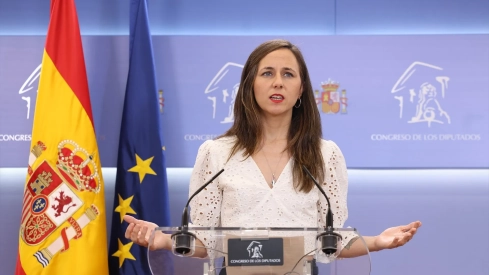
The general secretary of Podemos, Ione Belarra, has proposed electoral unity agreements with Izquierda Unida (IU) and with territorial parties in most of the autonomous communities, although she has left out of that scenario Madrid and Barcelona, two constituencies where she opens the door to competition with Frente Amplio.
Belarra conveyed this position in an interview on RNE, in which she defended an alliance with IU for the general elections in those territories where, she said, "only both forces exist". Among these cases, she cited Murcia, Cantabria, Asturias and, "of course, Andalusia".
The messages from regional leaders
The leader of Podemos has indicated that regional leaders of the purple formation "have thrown down the gauntlet" on social media, with appeals to revalidate electoral coalitions in those territories and to reproduce the formula of Unidas Podemos. In these messages, she stressed, Movimiento Sumar or Frente Amplio, the new space of the government's minority partners, do not appear in any case.
The approach, according to the Podemos leadership, focuses on preserving unity in those places where the electoral offer of the left is limited to these two forces, while reserving for other scenarios the possibility of different alliances or, directly, separate candidacies.
Catalonia and Madrid, outside the same scheme
Belarra has also excluded the constituency of Catalonia, where Podemos maintains a collaboration agreement with ERC, and the case of Madrid, where the distance with Frente Amplio is, she said, manifest. With this, she suggests that in both places there could be electoral competition within the left-wing space.
The Podemos leader pointed out that these are two more proportional constituencies, where "left-wing votes are not lost", an idea with which she again places the focus on the territorial distribution of the vote and the impact that fragmentation can have in each province.
The hypothesis of asymmetric agreements
Ione Belarra's proposal aligns with the option of asymmetric agreements that the former Podemos leader Pablo Iglesias had already raised as a hypothesis, who at the time argued that in territories such as Madrid and Barcelona, electoral fragmentation penalizes the left less because they are more proportional places.
With this argument, the general secretary of Podemos suggests a scenario in which the coalition would be the preferred formula in a large part of the autonomous map, while in the two large constituencies mentioned, the struggle between the different brands of the space to the left of the PSOE would remain open.
